close

Justin is a Partner and the National Director of Wealth Planning at Evercore Wealth Management, counseling advisors and clients on complex taxation, trusts and estates, charitable planning, and family governance issues. He additionally serves as a Senior Wealth and Fiduciary Advisor at the San Francisco office of Evercore Wealth Management and Evercore Trust Company.
Prior to joining Evercore in 2021, Justin was a national wealth strategist for 10 years at BNY Mellon. He previously was a managing director at Wells Fargo and began his career as a tax attorney at Sidley Austin.
Justin is an adjunct professor at Golden Gate University School of Law, a Fellow of the American Bar Foundation, and a Fellow of the American College of Trust and Estate Counsel. He has served in leadership positions with the American Bar Association, California Bar Foundation, San Francisco Estate Planning Council, and State Bar of California, and is a former editor-in-chief of the California Tax Lawyer. Additionally, he is a past recipient of the Outstanding Conference Speaker Award from the California Society of CPAs and the V. Judson Klein Award from the California Tax Bar.
Justin received a B.A., with honors, from the University of California, Berkeley, and a J.D. and LL.M. in Taxation from New York University School of Law. He also holds the Accredited Estate Planner® designation and CERTIFIED FINANCIAL PLANNER™ certification and is a member of the State Bar of California.

Making significant gifts to loved ones is arguably one of the most fraught wealth management decisions. Emotionally, we need to balance the joy of giving during our lifetimes with a potential loss of control and the prospect of unintended consequences. Practically, we need to weigh how much we can afford to give, with the realization that every dollar not transferred could be subject to a 40% federal estate tax (or more, if rates return to previous levels), as well as potential state estate taxes.
The last thing anyone wants is to have to borrow from their kids or grandkids later in life because they gave too much away. Whether you have $10 million or $100 million, a long-term cash-flow analysis – also called a lifestyle analysis – is a necessity. No one wants to be forced into significant drawdowns at the wrong time, which means that inflation and market volatility must be considered. In addition, wealthier people tend to live longer than average, and a longer life could bring unexpected and uninsurable medical expenses down the road.1
Sometimes, even those with more wealth than they would ever spend in multiple lifetimes might be afraid to give. In that case, it is important to address any anxiety from a psychological and emotional perspective, as well as from a practical one.
Some people want to know how much is enough. Other people want to learn how much is too much. Warren Buffett once said that the perfect amount to give children is “enough money so that they would feel they could do anything, but not so much that they could do nothing.”2 Unfortunately, there is no magic number.
Instead, the answer is to give loved ones no more than they are prepared for. An unprepared individual could receive a few hundred thousand dollars, and it could ruin their life – they might drop out of school, abuse drugs and alcohol, or develop a gambling addiction. On the other hand, a prepared person could be gifted millions of dollars and could still turn out well – continue to study hard, build a career, raise a family, and become a pillar of the community.
The key is to focus on preparing the family for the money. A team of good attorneys, accountants, and wealth managers should be able to help implement a successful long-term plan to invest the family’s assets and transfer the funds over multiple generations in a tax-efficient manner. The team should also focus on the work in preparing future generations for that financial wealth. This could involve financial education, communication and values exercises, and a focus on healthy family governance.
From a gift, estate, and generation-skipping transfer, or GST, tax perspective, giving sooner rather than later could provide substantial tax benefits. Not only can a married couple transfer up to $24.12 million completely free of taxes in 2022, but all the future growth of those assets could be free of any future gift, estate, and GST taxes. Moreover, the $24.12 million lifetime exemption amount per couple is set to be cut roughly in half after 2025, so families only have a relatively limited time to take advantage of the substantial potential tax savings from the larger use-it-or-lose-it exemption amount.
On the emotional front, not only do we want to see loved ones enjoy gifts while we are still alive, but studies have shown that giving to others can boost the giver’s happiness and satisfaction, increase life expectancy, reduce stress, and ease depression.3 Moreover, avoiding the topic of wealth transfer, to family members and to charity, could create more problems down the road. Even if family members currently get along, they might all end up fighting with each other over assets if they are not prepared for the wealth.
Before making any gift, it is important to prepare family members for that gift from a financial, psychological, and emotional perspective. There is not one perfect age at which to directly give money to a child or grandchild. Some young adults are perfectly equipped to manage millions of dollars in their 20s, while older adults might blow it all within a few years. The answer to when to give is only when they are ready. By starting with gifts of smaller amounts at younger ages, you can help the next generation learn to manage the wealth in an effective and healthy manner, develop greater responsibility, and become good stewards of the wealth in the future.
An individual can give to as many people as they want up to $16,000 per year – the annual exclusion amount as of 2022 – without any need to report the gift for tax purposes on a Form 709, United States Gift (and Generation-Skipping Transfer) Tax Return. In addition, individuals can pay anyone’s education or health care expenses directly without it counting toward their annual exclusion amount or lifetime exemption amount.
Making gifts to loved ones does not necessarily mean handing them cash. Instead of giving assets directly outright, gifts can be set up during the beneficiary’s lifetime for tax purposes by using trusts. In addition to tax benefits, those trusts can also be used to preserve assets as a safety net for the beneficiary’s lifetime – in other words, moderate how much is available to beneficiaries based on personal circumstances, such as supplemental income for education or consumption. Furthermore, trusts, along with the guidance and protection of a corporate trustee, could also provide beneficiaries with additional asset protection from potential creditors or even possible divorce in the future.
Setting aside gifts in trust now does not have to mean telling beneficiaries about the gift or handing them copies of account statements or balance sheets. While most states require that trust beneficiaries receive certain notices about a trust and the trust’s assets, there are some states – such as Delaware – that have special “silent trust” rules, which allow the grantor to keep information private.
Balancing equal with equitable can be a major planning challenge while trying to preserve family harmony. Differences in means and needs require each family to determine what fair means to them and what the future might hold. For example, family members with special needs may require additional financial assistance. At the same time, individuals who are financially successful now might need more support down the road due to a potential health condition or financial hardship in the future.
For many families, charity is often part of the overall wealth plan. From an income, gift, estate, and GST tax perspective, it is important to work with good advisors to structure charitable gifts in the most efficient manner for tax purposes. While a common approach is to set aside a portion of income for charity, a more recent approach among some families is to treat charity like a child when determining overall giving. For instance, a family with three children could set aside 25% for charity and the remaining 75% for the children. As discussed in the previous issue of Independent Thinking, a family philanthropy program also could be created so that generations can work together to support the family’s legacy.
Providing wealth to loved ones should truly be a gift, not simply a mechanical transfer of assets. If done correctly after preparing those loved ones for the wealth, it could provide a better quality of life, save on taxes, and prevent the negative impacts on those who are unprepared for the wealth. Consider working with your wealth advisor who can provide a financial analysis and help prepare future generations as part of an ongoing process. As Nathan Mayer Rothschild, son of the founder of the Rothschild banking dynasty, once said, “It requires a great deal of boldness and a great deal of caution to make a great fortune; and when you have got it, it requires ten times as much wit to keep it.”
Justin Miller is a Partner and National Director of Wealth Planning at Evercore Wealth Management. He can be contacted at justin.miller@evercore.com.
1 Glei DA, Lee C, Weinstein M, “Assessment of Mortality Disparities by Wealth Relative to Other Measures of Socioeconomic Status Among US Adults,” JAMA Network Open, 5(4):e226547. doi: 10.1001/jamanetworkopen.2022.6547 (Apr. 8, 2022); Finegood ED, Briley DA, Turiano NA, et al., “Association of Wealth with Longevity in US Adults at Midlife,” JAMA Health Forum, 2(7):e211652. doi: 10.1001/jamahealthforum.2021.1652 (Jul. 23, 2021).
2 Kirkland R, “Should You Leave It All to the Children?” Fortune (Sep. 29, 1986). George Clooney, as Matt King in the movie The Descendants (2011), said something similar, “you give your children enough money to do something but not enough to do nothing.”
3 Dunn EW, Aknin LB, Norton MI, “Spending money on others promotes happiness,” Science, Vol. 319, Issue 5870, pp. 1687-1688 (Mar 21 2008); Harbaugh W, Mayr U, Burghart D, “Neural Responses to Taxation and Voluntary Giving Reveal Motives for Charitable Donations,” Science, Vol. 316, Issue 5831, pp. 1622-1625 (Jun. 15, 2007).
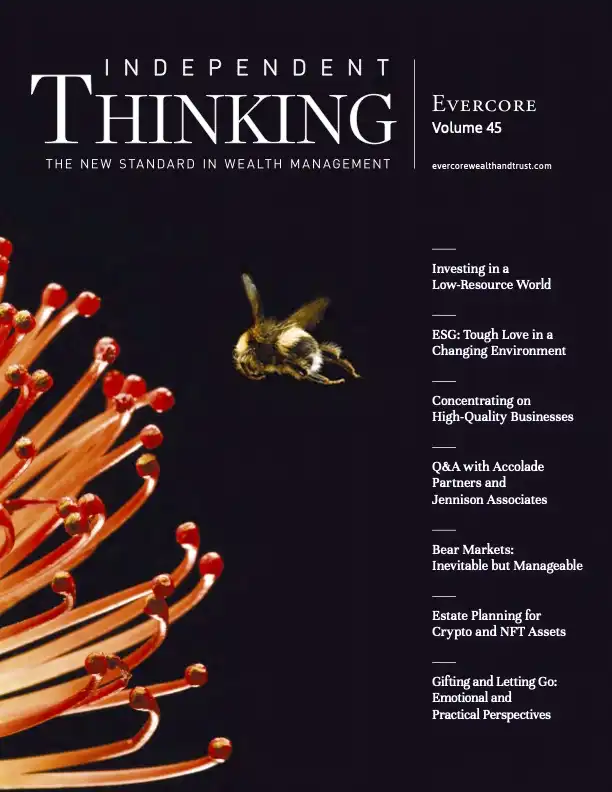
Volume 45 of Independent Thinking® by Evercore Wealth Management addresses the challenges and opportunities facing investors in a period marked by inflation, bear markets, and global economic shifts.
The publication emphasizes the importance of maintaining a long-term perspective and adapting investment strategies to a resource-constrained and increasingly deglobalized world. It explores the evolving landscape of ESG (Environmental, Social, and Governance) investing, the necessity of focusing on high-quality businesses, and the inevitability, but manageability, of bear markets.
Practical guidance is provided for estate planning in the digital age, especially regarding crypto and NFT assets, as well as for emotionally and strategically effective wealth transfer. Throughout, the issue encourages investors to remain resilient and proactive amid uncertainty.
Investment and Wealth Management services are provided by Evercore Wealth Management, LLC an investment advisor registered with the U.S. Securities and Exchange Commission (the "SEC") under the Investment Advisers Act of 1940. Registration with the SEC does not imply a certain level of skill or training. Trust and custody services are provided by Evercore Trust Company, N.A. a national trust bank regulated by the Office of the Comptroller of the Currency.
Client retention rate is based on data from 06/30/24 – 06/30/25. Assets under management are as of 06/30/25