

close
Volatile markets trigger anxiety and strong psychological reactions, making it a challenge to stay focused on wealth-planning fundamentals. The good news is that a market downturn can provide unique opportunities to strengthen a long-term strategic wealth plan. Here are some suggestions to stay on track, reduce risk and even take advantage of down markets in a volatile economic climate.
Certain foundational steps can help protect a wealth management portfolio in uncertain times.
Maintain Adequate Liquidity. Ensuring access to sufficient defensive assets – such as cash and Treasuries – for lifestyle needs and short-term obligations is the starting point. At current levels, markets could slide further, and having access to adequate liquidity reduces pressure to sell investments at depressed prices and trigger capital gains. Depending on the sources of income, it could be prudent to maintain adequate short-term reserves to cover at least one year of expenses. Setting up a secured line of credit could provide additional protection if necessary.
Recalibrate Asset Allocation. In addition to ensuring adequate defensive assets, a down market is an opportune time to reassess the overall investment mix in the context of individual and family risk tolerances, time horizons and financial objectives. Minor asset allocation adjustments can often help realign the investment strategy with long-term wealth-planning goals.
Tax-Loss Harvesting. If the portfolio includes positions with losses, consider harvesting them. Those tax losses can offset any current or future capital gains. From an asset allocation perspective, investors can reinvest in a similar index fund or exchange traded fund (ETF), to maintain a similar market exposure while avoiding the tax code’s wash-sale rule. This disallows losses when selling an investment if a “substantially identical investment” is purchased 30 days before or after the sale. To the extent that investors are working with multiple investment management firms, the lead advisor should coordinate the overall investment strategy so that one manager isn’t buying the same stock that another manager sold, which would disallow the loss under the wash-sale rule.
Adjust Timing for Charitable Giving. It may be prudent to wait until market values recover before making charitable gifts to a public charity, donor-advised fund or private foundation. Donating appreciated assets down the road can increase the impact of generosity while also allowing for a larger itemized deduction for the fair market value of the donation, free of any capital gains tax on the long-term appreciation.
Review Loans. With interest rates fluctuating, it’s worth reviewing current mortgages and other loans. Extending a fixed-rate period or locking in lower payments may improve financial flexibility.
While market downturns can be unsettling, they also open the door for long-term planning strategies.
Thoughtful Cash Investments. A drop in market values could be a compelling time to invest surplus cash. Investment entry points during market lows can pave the way for more significant long-term growth, especially as part of a rebalancing strategy aligned with long-term goals.
Roth IRA Conversion. Market dips provide a tax-efficient window to reduce the tax cost of converting traditional IRAs to Roth IRAs. You can pay tax on a lower asset value now and enjoy more potential tax-free growth moving forward. Investors can withdraw assets from a Roth IRA after age 59½, completely free of income taxes. Heirs can later withdraw remaining Roth IRA assets without any income taxes. Time horizon is key in evaluating this strategy.
Maximize the Lifetime Gift and Estate Tax Exemption. The current $13.99 million per person ($27.98 million per married couple) exemption presents a powerful opportunity for gift, estate and generation-skipping transfer, or GST, tax planning. Transferring assets when values are depressed locks in potential recovery and appreciation outside the taxable estate. Using trust strategies – such as spousal lifetime access trusts, or SLATs, grantor retained annuity trusts, or GRATs, sales to intentionally defective grantor trusts, or IDGTs, and/or Delaware dynasty trusts – can not only provide additional asset protection for loved ones, but all the potential market recovery and future growth of the assets can be transferred completely free of gift, estate and GST taxes to future generations.
Fix Underperforming GRATs. If a prior GRAT has underperformed, consider swapping in cash, bonds or promissory notes for the assets that have gone down in value, then re-GRAT those depressed assets to reset growth potential as part of a new GRAT strategy with a higher likelihood for success. In a way, the re-GRAT strategy is like “heads, you win; tails, you don’t lose.”
Updating a lifestyle and retirement financial planning analysis can help mitigate feelings of panic and prevent imprudent overreactions to a market downturn. Testing the plan against various market scenarios – including through our calculations around potential maximum drawdowns and periods of higher inflation – can help investors better assess the probability of financial success and identify any necessary changes. Examples of potential wealth-planning adjustments could include modifying spending levels, adjusting asset allocation, factoring in alternate income sources like employment, dividends, interest or trust distributions, and reassessing required minimum distributions.
While it’s natural to feel uneasy during market downturns, it is important to stay engaged. The right strategies can help investors weather today’s volatility while laying the groundwork for long-term success.
In an economically challenging environment with increased market volatility, staying in close contact with your wealth management advisor is more important than ever. If you’d like to revisit your wealth plan, discuss any of the strategies mentioned above, or simply talk through what’s on your mind, our Evercore Wealth Management team is here for you. Please don’t hesitate to reach out.
Justin Miller is a Partner and the National Director of Wealth Planning at Evercore Wealth Management and Evercore Trust Company. He can be reached at justin.miller@evercore.com.
Private fund principals have access to unique planning strategies that leverage both carried and capital interests to shelter assets from transfer taxes, and reduce and defer income taxes. Now is the time to take advantage of these strategies.
As described here, the lifetime individual federal gift, estate and GST tax exemptions are currently projected to drop to an estimated $7.16 million as of January 1, 2026, from the current $13.61 million per individual. Until then, a married couple that gifts $27.22 million to a trust for the benefit of children and grandchildren before the sunset could potentially avoid over $5 million of estate tax at the current 40% rate, and also possibly save heirs future gift, estate and GST tax on any growth of those assets with proper planning. Even if the exemptions are not reduced, gifting assets lowers estate taxes by 40 cents for every dollar of growth in the initial gift and could avoid additional state estate tax and GST tax.
So, what should private equity, private credit, and venture capital fund principals do? The following planning strategies could be considered:
The ideal asset to gift is one with a low value at the time of transfer with large upside potential. If you give $10 million into a trust that grows to $50 million at the time of your death, you have effectively moved $40 million of growth out of your taxable estate, saving heirs roughly $16 million in transfer taxes. Carried interest in a newly formed fund is the ideal asset to gift, as it arguably has a relatively smaller value at the initial closing but may have significant value in the coming years. Therefore, the carry can be gifted at a very low “cost” with potentially very high long-term value.
The problem with gifting carried interest is that the IRS, under Code Section 2701, does not allow a transfer of one interest in an asset while retaining another interest in the same asset. Fund managers often hold General Partner, Limited Partner and carried interests in their funds. If a manager tried to gift just the carry, the IRS would deem carried and all capital interests in the fund as a gift, which would be problematic and/or administratively impossible. Fortunately, there are two potential solutions to this problem.
The first is an exception to Section 2701 called a vertical slice. A fund manager can take a proportionate share of all their capital and carried interests in a fund and gift that “slice” to a grantor trust for the benefit of children and future generations. The vertical slice strategy is not as powerful as gifting only the carry, but it can transfer meaningful capital at its lowest valuation and potentially shelter future growth from estate taxation. However, there are certain considerations that must be kept in mind. The interests that are transferred will be subject to a proportionate share of capital contribution obligations. The trust that receives the interest should have enough liquidity to cover these capital calls. The manager’s advisors will need to be aware of any vesting requirements of the carried interest – unvested interests cannot be gifted. They will also need to know about any management fee offsets or other compensation arrangements.
The other strategy that fund principals can use is a sale of a derivative contract tied to the performance of a carried interest. A contract can be sold to an irrevocable trust that gives the trust some or all of the economic benefit of the carried interest above a hurdle over a period of time. This contract can be reasonably valued by a professional appraiser. Since the manager is not actually giving away the interest, only the economic benefit, a forced gift of the capital interest under Section 2701 is avoided. A derivative strategy could offer several advantages: It is administratively less burdensome; there are no capital call or vesting issues; and the most impactful asset from a tax savings perspective is gifted at a lower exemption cost than a vertical slice. However, given the complexity involved, this strategy may carry more audit risk. Principals also will need to beware of potential losses if the carry does not grow beyond the hurdle rate, death occurs before the contract expires (the contract will need to settle at that date), or a potential liquidity crunch if the contract term ends with a high carry value without any distributions.
Note that fund principals also may want to consider a Family Limited Partnership or Family LLC to pool other assets under one umbrella together with either one of the foregoing strategies. This can allow for easier administration and potentially further discounts to the valuation of the assets held in the partnership.
Successful mature funds generally have high valuations with relatively predictable cash flows. Fund managers who regularly donate to charity could consider transferring a portion of their mature funds to a Charitable Remainder Trust, or CRT, to reduce and defer income taxes. A CRT pays the fund manager a fixed annuity payment or percentage of the fund’s value every year. At the end of the trust’s term, any remaining value is transferred to a charitable beneficiary, which could include a donor-advised fund or private foundation. A CRT is a tax-exempt entity; therefore, when assets are transferred into the trust, the transferor receives an income tax deduction based on the estimated present value of the remainder, and the trust does not pay tax on any income generated by the fund. Instead, the fund manager will only pay a portion of the income taxes due upon receipt of the annual payments, making this an income tax deferral strategy.
Depending on the fund manager’s goals, a Charitable Lead Trust, or CLT, also could be an option. A CLT is similar to a CRT, except that the charity receives the annual payment, and the remainder can be transferred to heirs. A CLT can be set up as a grantor trust or a non-grantor trust. With a grantor trust, the fund manager receives an upfront charitable deduction but is subject to tax on the trust’s income each year. With a non-grantor trust, there is no upfront charitable deduction, but the trust receives a charitable deduction each year and the fund manager is not subject to tax on the trust’s income. Unlike a CRT, which is commonly used as an income tax planning strategy that also benefits charity after death, a CLT typically is utilized as more of an estate tax planning strategy that also benefits charity during life.
Fund managers who have already used their exemptions or who want to transfer only growth in their funds can use “freeze” strategies. The two most common are grantor retained annuity trusts, or GRATs, and sales to intentionally defective grantor trusts, or IDGTs. To summarize simply, GRATs transfer growth above the Section 7520 rate (4.4% as of October 2024) out of the estate while using almost no federal gift and estate tax exemption. One of the downsides of a GRAT, however, is that the GST exemption amount cannot be used effectively, making it less efficient for multigenerational asset transfers. Another option with potential for GST tax savings for transfers to trusts earmarked for grandchildren and beyond is a sale to an IDGT. (See a recent related article.) In this case, cash is gifted into a trust – typically 10% of the asset purchase amount – and the fund manager sells assets to the trust in exchange for a promissory note. Because the IDGT is a grantor trust, the sale to the trust is not treated as a taxable event for income tax purposes, but the asset can be removed from the grantor’s estate for gift, estate and GST tax purposes. The IDGT uses the cash and income received from the asset to pay annual interest on the note – often at the lowest applicable federal rate as published by the IRS. At the end of the promissory note’s term, the IDGT eventually repays the note while retaining all the growth in the asset minus the interest and principal paid back to the fund manager.
When deciding what strategies to use, private fund principals will need a team of advisors to help navigate the options in the context of long-term goals and giving viability. Proper execution and ongoing administration also are essential. Since this type of planning is highly technical, it should only be implemented with a team of advisors that includes attorneys, accountants, appraisers, and wealth managers who specialize in this area.
Sean Brady is a Managing Director and Wealth & Fiduciary Advisor at Evercore Wealth Management and Evercore Trust Company. He can be contacted at sean.brady@evercore.com.
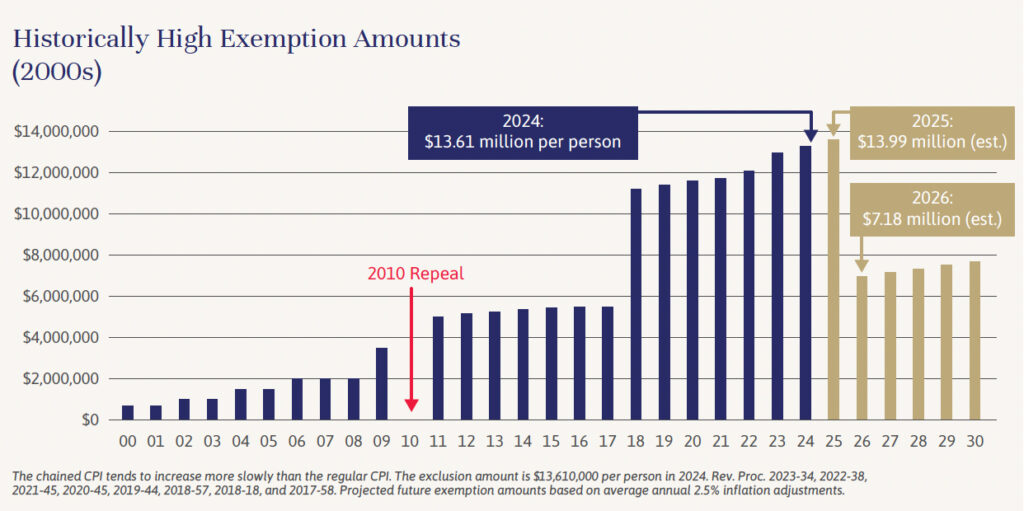
Sunset is when the sun appears to sink below the horizon. However, when it comes to estate planning, sunset is when the current gift, estate and generation-skipping transfer, or GST, tax exemption under the Tax Cuts and Jobs Act of 2017 gets cut approximately in half. After 2025, individuals will be limited to giving an estimated $7.18 million tax-free to their heirs, down from the current $13.61 million “use-it-or-lose-it” exemption amount. A historic window of opportunity to maximize intergenerational wealth transfer is set to close soon.
Depending on elections in November 2024, it is possible that Congress – with the future president’s approval – could extend the historically high exemption amount by passing legislation similar to the Tax Cuts and Jobs Act of 2017. However, such an extension seems unlikely at this point, given the extent to which it would increase deficits. The Congressional Budget Office recently estimated that the cost of extending just the exemption levels through 2033 would be approximately $167 billion.
If 2026 still seems a way off, consider that some trust and estate attorneys are already turning away clients as the deadline looms. Anyone able to take advantage of the full exemption who fails to use more than $7.18 million will likely lose the remainder as of 2026, as illustrated in the chart below. Also lost after 2025 will be all the potential estate-tax-free appreciation of those assets, perhaps for generations to come. If that $13.61 million generated, say, a net 7% return over 30 years, that’s more than $40 million of savings at the current 40% gift and estate tax rate. For an ultra-high net worth couple able to gift twice that amount, the savings would be more than $80 million.
In short, this is the time to address three key questions: Can you afford to gift? If so, how much? And what should you give?
Preserving peace of mind is the starting point. Individuals and couples need to know that they will retain sufficient assets to sustain their lifestyle and meet other goals – a decision that should be made only after a thorough financial analysis. And even if parents or grandparents are ready to give, family members might not be ready to receive. Next-generation readiness and, often, complex family dynamics must be considered too. For those whose financial analysis shows that they should not gift more than the $7.18 million threshold ahead of the sunset, it is still prudent to begin estate planning sooner rather than later to maximize potential future growth outside of the estate and reduce the potential future estate tax exposure.
Trusts can play a key role here, helping to ease this transition and in planning for the unknown, including future generations. Spousal lifetime access trusts, or SLATs, Dynasty Trusts, and Intentionally Defective Grantor Trusts, or IDGTs, can preserve and protect wealth (see below for a brief guide to these three trust structures). Structuring any trust as a grantor trust amplifies the power of estate planning, as the grantor continues to pay the income taxes on the trust. This allows trust assets to compound over time unencumbered by taxes while the grantor reduces the amount of their estate that could be subject to future estate taxes without using up any additional exemption amount.
Keep in mind that the choice of an individual and/or corporate trustee is critical. Both an individual trustee and corporate trustee should know the family well and be confident that they can carry out their duties for a long time. Moreover, an individual and corporate trustee can be named together as co-trustees where the corporate trustee can educate and otherwise support the individual trustee by lessening the administrative burden, as well as assisting with future trust management and governance issues. (For more information, please visit https://evercorewealthandtrust.com/choosing-the-right-trustees/).
The next consideration is generally which assets to give and how to structure those gifts. Cash, real estate, public securities and private investments each have associated implications that need to be considered, as illustrated below. Each situation is different, so it’s important to run different test scenarios taking into account factors such as basis, capital appreciation and liquidity – to evaluate the pros and cons of gifting each type of asset.
Cash is straightforward, as there are no concerns around valuation or embedded gains. However, most people have a limited amount of cash on hand, and what they do have is reserved for lifestyle needs. The next option would be publicly traded securities, which, while also relatively easy to gift, require the consideration of additional planning issues, such as embedded capital gains. It’s important to know that assets gifted during lifetime will retain their tax basis and will not receive a step-up in tax basis at death. In other words, many assets – other than certain exceptions like retirement accounts – will have all the capital gains disappear if still owned at death, which does not apply to assets given away during life.
Private investments, such as private equity funds, can also be a great option for gifting; although gifting such assets can often involve greater complexity. These assets typically have significantly lower valuations early on but can later grow substantially for the benefit of heirs. (See the article by Sean Brady on planning strategies for private fund principals.) Similar to private equity investments, closely held business interests and real property can also be powerful estate planning tools, especially taking into account potential lack of marketability and lack of control discounts for gift purposes.
There is no one optimal strategy for gifting that works for everyone. It’s vital to customize any gifting plan and weigh the trade-offs in gifting different types of assets by working with a collaborative team of advisors, including your wealth manager, attorney, accountant, and potentially other specialists. Gifting these amounts is a big decision, one that should only be made in the context of a comprehensive estate plan. But if gifting is a goal, there may be limited time to do it in the most tax-efficient manner.

Justin Miller is a Partner at Evercore Wealth Management and Evercore Trust Company and the National Director of Wealth Planning. He can be contacted at justin.miller@evercore.com. Neza Gallitano is a Managing Director and Wealth & Fiduciary Advisor; and Alex Pavelock is a Director and Wealth & Fiduciary Advisor. They can be contacted at, respectively, neza.gallitano@evercore.com and alex.pavelock@evercore.com.
To view Justin, Neza and Alex discussing this topic in a recent webinar or to learn more, please visit https://evercorewealthandtrust.com/independent-thinking-panel-gifting-before-the-estate-tax-exemption-sunset-the-whys-why-nots-and-when/ or contact your Evercore Wealth Management and Evercore Trust Company Advisor.
Editor’s note: This guide is extracted from an article published in Independent Thinking in 2021; the amounts have been adjusted to reflect subsequent inflation.
One of the most popular wealth transfer strategies is to create a Dynasty Trust in Delaware or in other states with strong asset protection laws, for children, grandchildren and future generations.
A Dynasty Trust could not only prevent future gift, estate and GST tax, but it could also help protect assets for family members from future creditors in the wake of any number of potential events, such as a car accident or divorce. For instance, a married couple could transfer $27.22 million tax-free into a Dynasty Trust. Those assets and all the future growth would be permanently set aside for family members without being subject to gift, estate or GST tax. Moreover, many asset protection trust states like Delaware have eliminated the common-law rule against perpetuities, which means the Dynasty Trust can support multiple generations of a family for hundreds of years.
Dynasty Trusts are often set up as grantor trusts, allowing the grantor to pay all the income tax for the trust without any gift tax consequences. In other words, the Dynasty Trust’s assets grow free of income tax, and the payment of income tax by the grantor further reduces the grantor’s taxable estate. On the other hand, wealthy families in high income-tax states may want to consider creating a non-grantor trust, where the trust pays its own tax, in a jurisdiction where the Dynasty Trust would not be subject to any state income tax. As a non-grantor trust in a state without a state income tax, the Dynasty Trust could continue to grow free of estate, gift and GST tax, as well as state income tax for generations – subject to potential state sourcing rules and throwback tax, for example, in California and New York.
Not all wealthy parents are comfortable permanently setting aside millions of dollars for children and future generations, especially if they might need or want the assets back in the future. In that case, a spousal lifetime access trust, or SLAT, could be the optimal solution to maximize the gift, estate and GST tax savings while still protecting assets for the spouses for the rest of their lifetimes. With a SLAT, one spouse would create a $13.61 million irrevocable trust with their separate property to benefit the second spouse. After the second spouse dies, the SLAT protects future generations, free of gift, estate and GST tax. It is important to remember that SLATs are irrevocable trusts, which could be a big issue if spouses get divorced in the future.
It may also be possible for the second spouse to create a similar $13.61 million SLAT for the first spouse. However, the two SLATs would need to be independent and different enough to avoid what is known as the “reciprocal trust doctrine” and “step transaction doctrine.” Accordingly, the first spouse is taking a real risk that the second spouse might not necessarily fund a second SLAT for the first spouse. Suppose there is concern about the reciprocal trust or step transaction doctrine. In that case, instead of the second spouse creating a similar SLAT for the first spouse, another option could be for the second spouse to utilize their individual $13.61 million exemption by creating an entirely different type of trust, such as a Dynasty Trust, for future generations.
Typically, SLATs are grantor trusts, similar to Dynasty Trusts. As an alternative, careful drafting may make it possible to create a spousal lifetime access non-grantor trust, or SLANT. As a non-grantor trust, the SLANT would grow free of state income tax in a jurisdiction such as Delaware, subject to potential state sourcing rules and throwback tax, for example, in California and New York.
Families looking to maximize the amount they can leave to future generations free of gift, estate and GST tax can consider several strategies that maximize use of the current high exemption amounts. A sale to an intentionally defective grantor trust, or IDGT, which could be a Dynasty Trust or SLAT, is one of the most powerful strategies to set aside substantial amounts of assets for future generations. Typically, the first step is to fund the IDGT with an amount equal to 10% of the assets that the IDGT will be acquiring. The initial gift is often referred to as seeding the trust, although some practitioners are comfortable eliminating this step if there are adequate beneficiary guarantees.
For example, a married couple who are parents could gift $20 million to an IDGT without fully utilizing their entire combined exemption amount, and the IDGT could then buy $200 million worth of assets from the parents for a promissory note. The IRS publishes applicable federal rates monthly; the minimum interest-only payment that the parents would need to charge on a promissory note for 30 years would be 4.1% (for a loan made in October 2024). To make the sale to IDGT strategy even more effective, wealthy families often sell assets, such as closely held business interests, to the IDGT at a discount due to their lack of marketability and control. Families could create a family limited partnership, or FLP, or a family LLC to manage the family’s investments. It is essential that the entity has a legitimate business purpose and that the family respects both the form and substance of the structure. For instance, an FLP interest could have a $300 million undiscounted value but could be purchased by the IDGT for a $200 million promissory note if a valuation provided a 33.33% discount for lack of marketability and control. If such an asset had a 7% net growth rate over a 30-year period, approximately $1.5 billion could be transferred to future generations completely free of gift, estate and GST tax.
Every family has unique characteristics and dynamics, and again, any plan should reflect the collaborative counsel of advisors, including a Wealth & Fiduciary Advisor, attorney and accountant. A professional appraiser also should be included to value assets other than cash or publicly traded securities. And don’t forget to file Form 709, United States Gift (and Generation-Skipping Transfer) Tax Return, to report any gifts that take advantage of the exemption amount.
Every divorce is unique, but no one needs to feel alone in the experience. Building a team of advisors, including an attorney, an accountant, and a wealth management advisor, is the first step in working to a positive outcome – and a fresh start.
Like most preventative measures, pre- and post-nuptial agreements can feel difficult in the present, but they can save a lot of grief in the longer term. Please see below for a brief overview.
There are typically four types of divorce proceedings: self-settled divorce (no attorneys, no mediators), mediated divorce (no attorneys, but a qualified mediator representing both spouses), collaborative divorce (each spouse hires their own attorney but divorce proceeds outside of court), and litigated divorce (both spouses hire attorneys, and the case is presided over by a judge in court). In any case, it is wise to meet with an accountant and wealth advisor in conjunction with legal counsel.
Each state has different rules and case law governing divorces and asset settlements. Within the nine community property states, for example, assets are deemed community or separate property of one spouse, and all community property will typically be divided equally.1 Conversely, equitable distribution states split all assets, earnings, debts, and property in a division in a manner meant to be fair but not necessarily equal.
Custody of minor children or any suspicion of nefarious activity and hidden assets should be discussed with an attorney.
The most important starting point in a divorce negotiation is to build a firm understanding of the current balance sheet and income statement. A wealth advisor and a tax specialist can help identify and value assets and liabilities, as well as income and expenses. The chart below can serve as a primer of the types of assets you may identify, but this will vary from individual to individual.
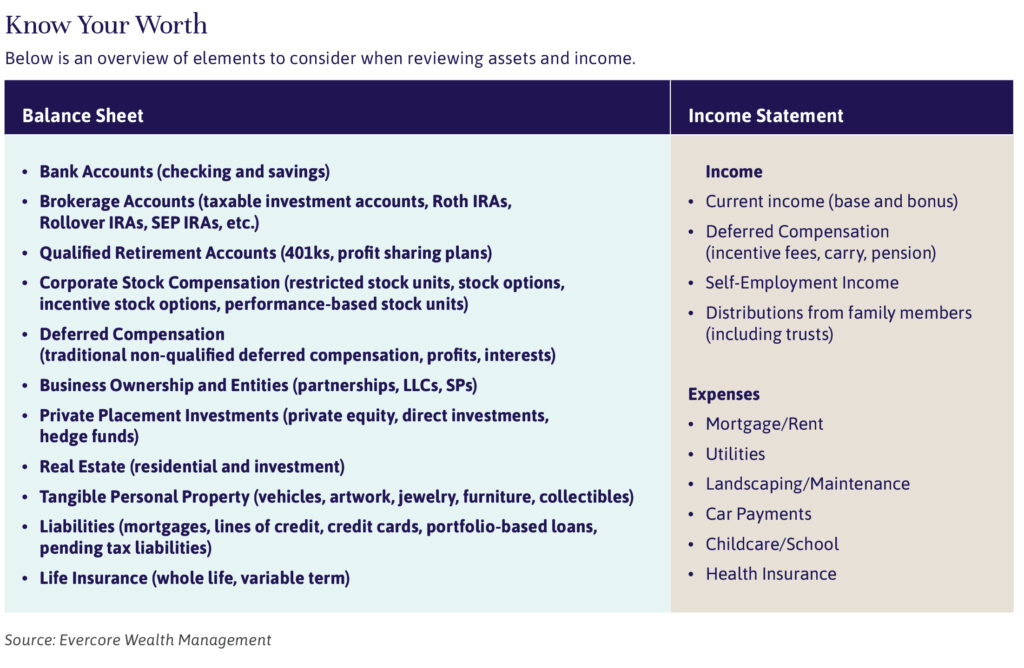
Some assets, like homes or artwork, cannot be split, and so adjustments are made to the division of other assets to adjust for those values. This is a potential pitfall for many divorcing spouses, as personal preferences may drive decisions that undermine future lifestyle spending.
A thorough understanding of attributes of various types of assets is required before deciding what makes sense for each individual. For example, the family home may prove expensive, with carrying costs including local property taxes, insurance, maintenance, and repairs. Selling it later may incur substantial transaction and tax costs not accounted for in the divorce settlement. Further, once a divorce is finalized, the spouse that retains the primary residence loses their former spouse’s potential capital gains exemption (currently $250,000). Assets should be evaluated on a net basis and in the context of an individual’s income, liquidity, and risk profile.
Here’s another example: The inherent value of an IRA, which is not accessible without penalties until age 59½ and is taxed as ordinary income when distributed, is not equal in value to a brokerage account invested in fully liquid securities taxed at capital gains rates. Similarly, a brokerage account invested in equity securities with a large, embedded capital gain and low income yield does not have the same tax implications, income generation or risk profile as a portfolio comprised of municipal bond securities generating tax-exempt income.
It is also important to identify and review assets that may hold little value now but could be worth more in the future. Some are more easily valued, such as restricted stock units vesting over time, while others may not be so, such as interests in a private company that could be headed toward a liquidity event. Even if the current value is negligible, analysis should be given to potential future value of the assets before they are dismissed as part of the asset split.
Balance sheet items outside an individual’s taxable estate are also important to incorporate in divorce planning. If either spouse is a beneficiary of an irrevocable trust with distributions that benefited the marriage, this may be considered as part of the negotiation around alimony and maintenance payments. Parents should consider whether any accounts have been set up for their children’s education or future benefit, such as 529 plans, Uniform Transfers to Minors Act accounts, or UTMAs, and irrevocable trusts.
In negotiating alimony payments and asset splits, it is important to identify current lifestyle costs, on a pre- and post-tax basis. Some expenses may decrease post-divorce while others, such as healthcare insurance or housing/mortgage servicing, may go up. Anyone counting on alimony should also consider securing agreement or insurance that the payments will continue in the event of the payor’s disability or death. A lifestyle analysis, a long-term financial planning tool, can also be incorporated as the divorce is being worked through to help identify what various settlement plans might mean for an individual’s future financial picture.
The divorce is finalized and your assets equitably split. Now what? A balance sheet is once again the starting point of the financial planning discussion – this time focused on defining the future.
Creating a lifestyle analysis incorporates current income, such as wages, investment income, and alimony, as well as current and future expenses. It provides a basis for the discussion around how to build a portfolio to achieve future goals. As with any major change, it may take a while to figure out what the new normal is.
Divorce is a complete overhaul to each spouse’s financial picture that needs to be reevaluated. Part of that is redefining an investor’s risk tolerance post-divorce. Simply put, risk tolerance refers to an investor’s willingness and ability to endure fluctuations in the value of their investments in pursuit of potentially higher returns. One might find that with a changed financial situation, and no longer making decisions in conjunction with a spouse, one’s risk tolerance is different than it was. It is also important to consider an individual’s new tax profile when deciding on underlying investment vehicles and creating an annual capital gains budget. Understanding – and regularly revisiting – risk tolerance and asset allocation is essential in constructing a portfolio that aligns with financial goals, time horizon, and emotional comfort level.
It’s also worth noting that divorce often comes with a heavy administrative burden. While some to-do’s may be top of mind, such as name changes and home titles, others, including estate documents, retirement beneficiary designations, and asset and debt titling, are just as crucial.
A wealth advisor can assist throughout the divorce process and beyond, helping with both financial and nonfinancial needs. Developing a thorough understanding of the current balance sheet, lifestyle needs, goals, and appetite for risk can go a long way in making informed decisions and easing a significant transition.
Judy Moses is a Partner and Portfolio Manager at Evercore Wealth Management. She can be contacted at moses@evercore.com. Neza Gallitano is a Managing Director and Wealth and Fiduciary Advisor at Evercore Wealth Management and Evercore Trust Company. She holds the Certified Divorce Financial Analyst designation. She can be contacted at neza.gallitano@evercore.com.
A prenuptial agreement is a legally enforceable written agreement made by a couple before marriage. It discloses a full and fair list of all property and debts of each partner and spells out the treatment in the event of the dissolution of the marriage or death. It can also discuss the treatment of future earnings and spousal support. The agreement will define what is separate and what is marital property; these assets should stay that way during the duration of the marriage.
Families often use trusts to try to protect family assets. However, distributions from a trust, if comingled with marital assets, could become marital property. In some states, a beneficiary of a trust may have trust assets treated as marital property. Irrevocable trusts cannot be changed except under certain circumstances. Prenuptial agreements can further help solidify protection of these assets.
A prenuptial agreement protects both spouses. For the spouse entering the marriage with assets, it can protect an inheritance, closely held business or other family legacy asset from leaving the family line. It also protects an individual entering a second or subsequent marriage. Importantly, it can protect an individual from taking responsibility for the debts of the other spouse. On the other hand, it can also protect the less affluent spouse, especially when that individual relies on the other spouse for income.
A prenuptial agreement requires both parties to have adequate legal representation and to fully disclose all significant assets. Generally, the agreement should be signed in writing before a notary at some period before the wedding. As with any contract, a prenuptial agreement can be renegotiated at any time.
Your Evercore Wealth Management Wealth and Fiduciary Advisor can help you and your attorney design a prenuptial agreement by reviewing your financial statements and advising on whether your future lifestyle needs will be met under the agreement.
– NG
The wonderful thing about growing up in one country and living in another is that you get to come “home” twice on a single visit. But managing family assets across borders can feel like more than twice the work.
Families with international connections often need to comply with the laws of both the United States and their home country, which may have significant differences in tax, legal, and accountancy principles. The result can be a complex web of legal, tax, and investment challenges. Add in a third or fourth jurisdiction, and the risk of costly mistakes multiplies exponentially. Consider the fact that while every U.S. state other than Louisiana uses a “common law” system (based on traditional English law), most European and Latin American countries apply a “civil law” system. Civil law countries are more likely to have forced heirship rules, limit flexibility of disposition, and give little legal effect to trust structures. Furthermore, even ostensibly common law jurisdictions like the United Kingdom and Canada differ significantly from the United States in how they treat traditional estate planning structures.
Americans living abroad may face even more complex challenges. Unlike citizens of just about every other country (except Hungary and Eritrea, at present), American citizens continue to be subject to U.S. income, estate, and gift tax rules, regardless of where they live or where their property is located. The United States has treaties in place with many countries, which may help to offset the effects of competing jurisdictions, but navigating the complex interplay of different systems can be treacherous.
Even relatively small distances can loom large if there’s a border in between. For example, if one spouse is a U.S. citizen and the other Canadian, chances are that, regardless of which country they live in, they hold investable assets in both, and are therefore subject to multiple (often conflicting) tax, legal, and reporting requirements. It may be difficult to find a single wealth management professional able to cover all sides of that equation.
Accordingly, any dual (or more) nationality families are best served by a team of advisors with the knowledge and confidence to review both the U.S. and international aspects of their estate plan and investment portfolio. In addition to the requisite legal, technical, and financial expertise, this team of advisors also needs the structural support necessary to satisfy all tax, compliance, and reporting requirements, including the ability to track cost basis in accordance with the tax and accounting rules of both jurisdictions.
Similarly, dual or multinational families need advisors who can continually review their charitable giving, retirement planning, and saving for their children’s education to maximize the tax benefits in each country. Remember that mainstream U.S. tax-deferral vehicles like IRAs and 529 plans may not be given the same special treatment in other countries.
Perhaps the most pressing issue for many families with a non-U.S. citizen member (particularly, a spouse) is the looming sunset of the current estate and gift tax exemptions at the end of 2025 (currently $13.61 million for 2024 and estimated to drop to around $7.5 million at the end of 2025). Under U.S. law, noncitizen spouses do not benefit from an unlimited marital deduction for gift and estate tax purposes. Similarly, the “portability” rules allowing a surviving spouse to carry over any unused exemption are not available. Therefore, it is even more important for a U.S. resident or citizen with a non-U.S. spouse to consider using the increased exemptions to make lifetime gifts to that spouse before the sunset.
Multinational families are common now, as members move to a new country but maintain their ties with the old. It’s not the simple life, that’s for sure. But with the appropriate planning, it can be a wonderful way to live, rich in perspective and opportunity, as well as challenges.
Alex Lyden is the Chief Fiduciary Officer at Evercore Trust Company, based in Wilmington, Delaware. He can be reached at alex.lyden@evercore.com.
Life insurance is often unnecessary for ultra-high net worth families. But in the right circumstances it can be a powerful planning tool, helping to provide estate liquidity, fund buy/sell agreements, or shelter taxes. Here are a few brief highlights:
Income replacement. High earners, as opposed to those with considerable assets, should consider life insurance (and possibly disability insurance) if the loss of income would materially affect their family’s quality of life. Term insurance is usually sufficient to mitigate this risk. Cash-flow projections will be important in determining the size and duration of the policy, but it’s fair to say that most young families could benefit from some form of coverage.
Estate liquidity. Families with a taxable estate of primarily illiquid assets, such as real estate or a family business, can arrange for life insurance to pay state and federal estate taxes, avoiding a forced sale at the owner’s death. Section 303 of the Internal Revenue Code allows an estate to sell shares back to a closely held business to cover estate taxes without being taxed as a dividend distribution in certain cases. Section 6166 allows beneficiaries to extend payments for all or part of the estate taxes attributable to the business for up to 14 years if certain conditions are met. Executing these arrangements can be a complicated and costly process, however, and should be considered very carefully.
If estate liquidity is an issue for a married couple, a simple solution may be a second-to-die universal life insurance policy. Usually, a well-planned estate pays taxes only at the passing of the surviving spouse. A second-to-die policy will only pay out on the death of both spouses, which drives down the cost of insurance. It provides long-term coverage at a relatively low cost.
Estate equalization. Parents who want to transfer a family-owned business to children active in the business without shortchanging other children can also consider a second-to-die universal life policy if there are not enough assets to equalize inheritances. Again, comprehensive estate and trust planning is necessary in navigating the related tax, control, and distribution issues.
Funding buy/sell agreements. Business partners can arrange for insurance to help cover the purchase of shares at the death of one or more of the partners. These policies work best as part of a robust buy/sell agreement and business succession plan that details business continuity in the event of retirement, disability, or death. Term or universal insurance may be appropriate, depending on the broader plan and participants.
Tax sheltering. Private placement life insurance, or PPLI, is a form of variable universal life insurance that can be a powerful tax sheltering tool for high earners with large balance sheets and significant liquidity. These policies allocate investments to liquid and to illiquid investments, such as hedge funds or private equity partnership interests, and shelter the income tax liability generated from distributions. Policyholders should have a decades-long investment time horizon, but the result can be a significant savings on income and, eventually, estate taxes, especially when combined with an irrevocable life insurance trust.
It should be noted that PPLI has come under recent scrutiny, with the Senate Finance Committee suggesting that regulators take a closer look at these policies.
When deciding where to get advice on your policy, remember that an insurance provider’s sales incentives should not drive your decisions in buying, keeping, or terminating an insurance policy. Please contact your advisor at Evercore Wealth Management and Evercore Trust Company, N.A. for an objective discussion of your family’s insurance needs and how insurance fits in with other aspects of your comprehensive wealth plan.
Sean Brady is a Managing Director and Wealth and Fiduciary Advisor at Evercore Wealth Management and Evercore Trust Company. He can be contacted at sean.brady@evercore.com.
Here are the major types of life insurance and considerations for high net worth and
ultra-high net worth families:
– SB
Editor’s note: Evercore Wealth Management released its legislative and regulatory guide in October to inform clients of end-of-year planning discussions in the context of overall wealth planning goals.
Highlights and subsequent relevant IRS updates are included here. Please contact your advisor for further information or to discuss your specific circumstances.
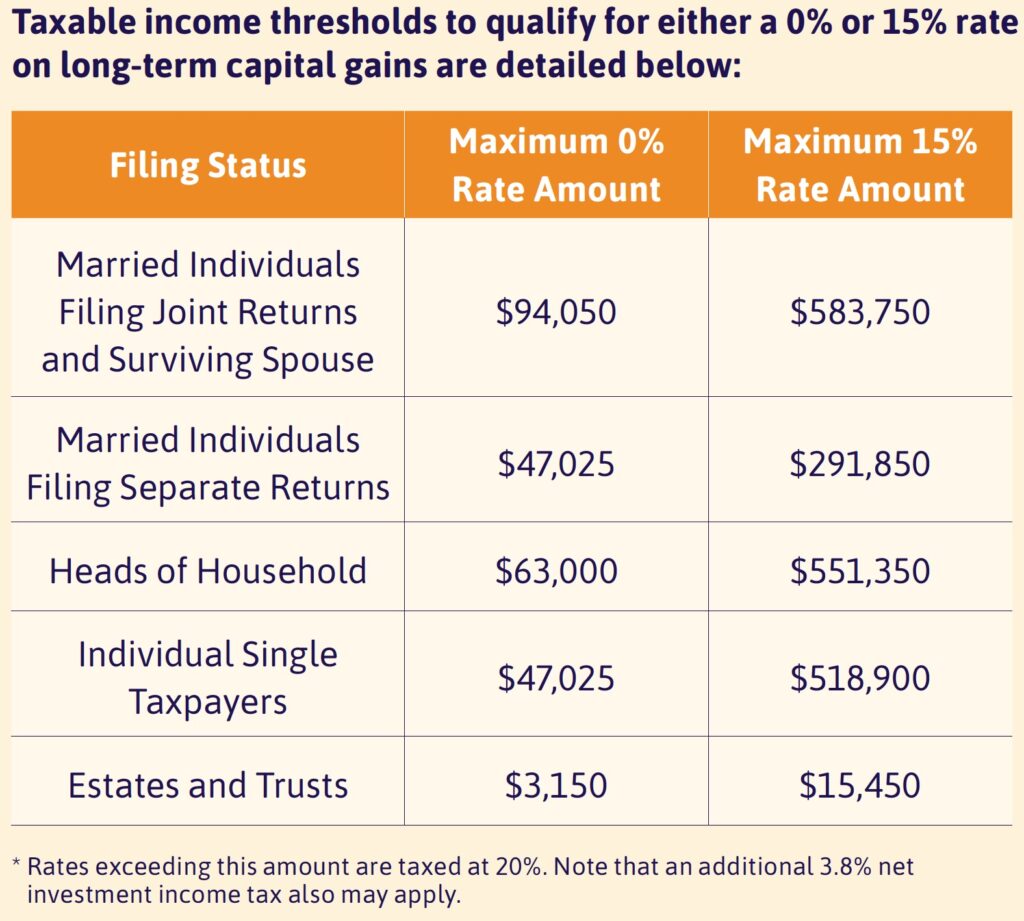
For tax year 2024, the top marginal tax rate remains 37% for individual single taxpayers with incomes greater than $609,350, married couples filing jointly with incomes greater than $731,200, and estates and trusts with incomes greater than $15,20
The new Setting Every Community Up for Retirement Enhancement (SECURE) Act 2.0 included adjustments to required minimum distributions and qualified charitable distributions. In addition, guidance issued by the IRS addressed estate tax portability elections, and a recent tax court opinion highlighted the importance of careful planning and timing of charitable contributions ahead of a liquidity event. The age for RMDs was raised from 72 to 73 as of January 1, 2023, and will rise again to 75 on January 1, 2033.
Qualified Charitable Distributions (QCDs)
Currently, an individual who is 70 1/2 or older can make QCDs up to $100,000 directly from an IRA to a qualified charity – but not to a donor-advised fund. Beginning in 2024, the QCD amount will be indexed for inflation to $105,000.
Individuals who are 70 1/2 or older are now permitted a one-time QCD of up to $50,000 from an IRA to a charitable gift annuity (CGA), charitable remainder unitrust (CRUT), or charitable remainder annuity trust (CRAT) that benefits the participant or their spouse. For more information, please speak with your Wealth Advisor.
Inflation Reduction Act
The Inflation Reduction Act was passed in 2022 and continues to be implemented. It includes a wide variety of legislation targeting many different sectors of the economy. Among its provisions are:
Gift and Estate Tax
The 2024 lifetime gift and estate tax exemption will be $13,610,000, an increase of $690,000 from 2023 levels. Additionally, the annual gift tax exclusion amount will be $18,000 for gifts made in 2024, an increase of $1,000 from 2023.
As always, we recommend meeting with your Evercore Wealth Management advisor, your attorney and your accountant before implementing new strategies to ensure that they are aligned with your long-term goals.
Like professional athletes, corporate executives are often paid for performance.
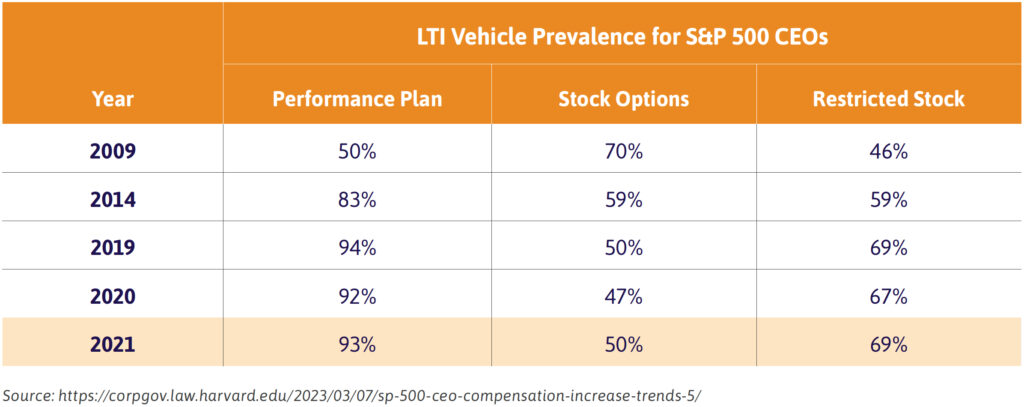
Unlike many athletes, executives may have more time on their side, thanks to deferred pay compensation structures that reward those who hang in there – and plan well. And it’s not just the top players who benefit. In recent years, companies have expanded deferred compensation packages well beyond the C-suite, in some cases to nearly all employees. Long-term incentives as a proportion of C-suite executive pay have more than tripled over the last few decades to about 70% of total pay.
That proportion is likely to continue rising in the wake of the 2022 ruling by the Securities and Exchange Commission, or SEC, on “Pay vs. Performance,” which requires companies to disclose executive compensation along four specific measures, as illustrated below. The ruling is the latest step to pay transparency, which started with the “Say on Pay” ruling in 2011 as part of the Dodd-Frank Act. Shareholders and boards want to see that executives have skin in the game, and by large, executives have benefited enormously. Let’s take a quick look at the most common types of executive compensation, along with the advantages, drawbacks, and other considerations. Many companies will provide a mix of compensation structures, with the most common features including cash compensation with additional incentive compensation in the form of restricted stock and performance-based restricted stock.
Stock options are a powerful, tax-efficient tool to compensate executives, which gained immense popularity in the 1950s when marginal tax brackets were much higher. If the underlying stock price grows, the owner of a stock option can participate in those gains while simultaneously deferring tax until the exercise of the option. And if the underlying stock price falls below the strike price, the owner of the options can simply let them expire; the only downside is opportunity cost. Further, if the stock options are qualified incentive stock options and the holding requirements are met, the owner may be able to avoid ordinary income tax due when they exercise the options and on the difference between the sale price and the strike (purchase) price at disposition of the shares. Although, it is important to note that the exercise of incentive stock options could result in significant alternative minimum tax consequences.
Other types of stock awards also align the executive and shareholder goals. In other words, everyone makes more if the company does well. Although, noncash awards may carry more risk for the executive. Restricted stock and restricted stock units, or RSUs, are taxed as ordinary income at the time of vesting. Unless the share owner is able to simultaneously sell shares at the time of vesting, this means that the tax bill is due before the liquidity is available and cash must be used from other sources. Performance-based restricted stock units, or PSUs, vest only if the company hits certain performance targets and are thereafter taxed like RSUs. PSUs are especially appealing for companies and boards, as they motivate executives to meet performance targets while also allowing companies to present large compensation packages to attract executives.
There are several other compensation structures that are available but less prevalent, such as traditional deferred compensation plans, long-term incentive plans (or LTIPs) and performance stock plan “kickers” (whereby additional discretionary stock grants can be made for superior performance). Employees should note that forced bonus deferrals are often made to non-qualified deferred compensation plans. These plans are subject to the creditor risks of the company, which should be taken into account when considering how much to defer and how to plan for these funds. Companies often implement new compensation measures trying to balance current year fiscal reporting while competing to attract top-tier talent.
In just about all cases, employee shares in both public and private companies are often required to be held in the employee’s own name. Transfers to family trusts or family members are either prohibited or very restricted. As a result, sometimes the largest asset on an individual’s balance sheet cannot be used to take advantage of the current lifetime estate tax exemption amounts.
Therefore it is important to maximize estate planning techniques available for unrestricted assets, as well as develop a plan to incorporate company stock assets into the estate plan once they become unrestricted. Some companies do allow vested shares of common stock to be reassigned, so it is also important for employees to understand the specific policies of their incentive compensation plans.
Companies competing for talent at all levels put together enticing compensation packages but are equally motivated to push much of this compensation into long-term payout structures, thereby tying employee compensation to tenure. Further, companies have different vesting conditions in the case of termination or change of control. It is important for employee shareholders to understand how their shares vest, or don’t vest, in each of these scenarios to calculate a net present value of their compensation, which can guide future decision making.
Often, employee shareholders do not actually diversify away from company holdings until they leave that role. The bull market that we’ve seen since March of 2009 and record IPO valuations have made it easy for employee shareholders to stay invested. Without proper planning, though, employees could be left holding the bag. Employee stockholders who worked at Lehman Brothers in the first two weeks of September 2008 saw their net worth invested in company stock drop 46% before being completely wiped away in one day. More recently, the COVID-19 pandemic caused some companies’ values to soar (such as Zoom and Peloton), while others plummeted (such as airline stocks and hotel brands). Both Zoom and Peloton shares have fallen back to pre-pandemic levels, off 89% and 97% of their COVID-19 era peaks, respectively. This year, employees and other shareholders of First Republic Bank lost nearly all the value in their holdings as the share price lost over 90% of its value over a period of six weeks in February and March 2023, before losing nearly all remaining value before May. Executives at WeWork and Twitter had similar experiences as fraught management caused share values to tumble. While these examples are extreme, even lower levels of volatility can impact an individual’s cash flow plans or retirement timing.
Diversification is therefore a crucial part of the planning process for executives. However, sale restrictions, trading windows, and tacit expectations not to sell stock can often prevent employee shareholders from fully diversifying their concentrated positions, which further exposes their net worth to large fluctuations and volatility. One simple way for employees to diversify away from company stock is to elect shares to be sold upon vesting or exercise to cover income tax withholding. Some companies even allow employees to elect a higher withholding rate than the statutory federal withholding rate of 22%, thereby allowing them to fully cover their tax liability. Selling shares to cover tax withholding allows individuals to reduce their overall employee stock exposure while preserving cash and other assets outside of the concentrated stock. It is important to work with a wealth planning advisor and a CPA to properly plan for tax liabilities associated with vesting of restricted shares or the exercise of options.
10b5-1 plans are often established to allow insiders of public-traded corporations to set up a trading plan for selling company stock they own while abiding by insider trading laws. Documents pertaining to these plans set forth certain events, whether date-based or stock-price based, at which an executive’s shares will be sold. Plans can stipulate various time frames, but typically are in force for six months to two years. While it may be possible to modify and terminate an existing plan, such changes are subject to significant limitations.
Proper planning can enable executives to ensure that they are meeting lifestyle and tax liability needs through their direct (cash) payments while addressing their incentive payments in the context of longer-term goals. This planning should consider various scenarios, including those in which the company performance metrics miss their mark and shares don’t vest. With the right planning, an executive will be fully apprised of the existing and potential value of a compensation package involving stock and have the power to understand and negotiate for future roles. Most important, proper planning allows individuals to maximize their balance sheet and cash flow and make informed diversification decisions to preserve their earnings for years to come.
It’s also worth noting that different companies call these incentive plans by different names, in which case a wealth advisor could help identify the plan and its advantages and constraints.
Neza Gallitano is a Managing Director and Wealth & Fiduciary Advisor at Evercore Wealth Management and Evercore Trust Company, N.A. She can be contacted at neza.gallitano@evercore.com.
Several legislative and regulatory updates that may be worth considering this year, in the context of overall wealth planning goals.
For instance, the SECURE 2.0 Act included adjustments to required minimum distributions and qualified charitable distributions. In addition, guidance issued by the IRS addressed estate tax portability elections, and a recent tax court opinion highlighted the importance of careful planning and timing of charitable contributions ahead of a liquidity event.
Please contact wealthmanagement@evercore.com if you would like to learn more about our 2023 Year-End Wealth Planning Review, our annual guide, to highlight potential opportunities and strategies ahead of planning discussions with our clients.
You may have heard the proverb “shirtsleeves to shirtsleeves in three generations,” but did you know that Italians say that families go “from stalls to stars to stalls”; Chinese caution that “wealth never survives three generations”; Mexicans warn of “first-generation traders, second-generation gentlemen and third-generation beggars”; and Swedes sum it up with the stark “acquire, inherit, ruin?”
Regardless of the country, culture or even tax laws, there appears to be a sense that when families attempt to transfer wealth to future generations, something vital is often lost.
It doesn’t have to be this way, of course. Families that successfully transfer wealth think long and hard about what they are trying to preserve – and why they are trying to preserve it. They focus on preserving nonfinancial capital in addition to financial capital. This can include individual capital, or each family member’s personal strengths and talents; collective capital, such as family members supporting each other; community capital, which includes the family’s contributions to the local community; and spiritual capital, which can take many forms but drives the family’s ethos. In short, they transfer values along with money.
Communication is a crucial element in maintaining success. Much has been written about the significant differences among generations – from Baby Boomers and Generation X, on to Generation Y (the Millennials), Generation Z, and the most recent Generation Alpha. Successful families acknowledge that the life experiences of grandchildren and future generations are going to be very different from those of their grandparents. As an example, according to a 2021 Pew Research Center survey, more than two-thirds (68%) of U.S. respondents said they think today’s children will be financially worse off as adults than their parents.1 For wealthy families, this is an even bigger challenge, given the relatively higher starting point. A recent Stanford study found that approximately 90% of those born in the 1940s earned more than their parents as adults, compared to only about half of those born in the 1980s.2
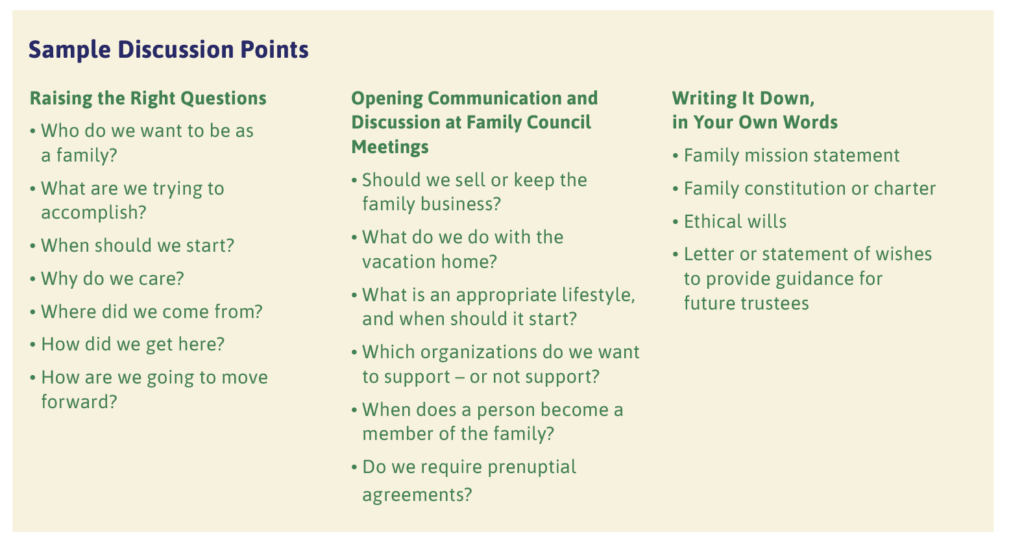
Demographics, addressed from an investment point of view in this issue of Independent Thinking, shouldn’t need to shape a family’s destiny – not if differing perspectives are raised and addressed. To encourage healthy communication, regular family council meetings can be surprisingly effective. Family council meetings can provide every member of the family an opportunity to proactively contribute to the family’s long-term success while preserving the role of the matriarch and/or patriarch. Please take a look at the chart below for some sample discussion points.
Another key factor for successful families is that that they tend to be philanthropic. Indeed, studies have shown that philanthropy actively fosters happiness – as well as the potential for significant tax savings.3 In preparing the next generation to be happy and productive members of society, family philanthropy – or giving to charity collaboratively as a family – could be one of the most impactful activities to consider.4 James E. Hughes, Jr., the author of Family Wealth, put it best when he observed that: “Paradoxically, families often learn more about long-term wealth preservation through the process of learning to give away than by the process of learning to accumulate and spend.”
While healthy family governance is a vital part of multigenerational success, families can’t ignore the importance of comprehensive tax and investment planning. Since no one advisor can or should do it all, successful families rely on a collaborative team of advisors to provide a cohesive strategy for growing and preserving wealth across multiple generations. That should also include all the left-brain wealth management responsibilities, such as legal documents, asset protection, privacy, confidentiality, taxes, investments, and so on. And it should also include all the right-brain family-oriented issues: an understanding of the family’s mission, vision, and values; educating family members; and supporting future family leadership. After all, successful families don’t just care about transferring the maximum amount of assets in the most tax-efficient manner to future generations, they also focus on preserving family harmony so that their family legacy will continue for future generations.
It’s worth recalling Warren Buffett’s well-known line on giving his children “enough money so that they could feel they could do anything, but not so much that they could do nothing.”5 The challenge for families is that there is no magic dollar figure when it comes to transferring wealth to future generations in a manner that helps – rather than hinders – their future happiness and success. Anyone struggling to identify how much money that might be should instead follow the secrets of successful families and consider the more important question: “What have you prepared them for?”
Justin Miller is the National Director of Wealth Planning at Evercore Wealth Management and Evercore Trust Company, N.A. He can be contacted at justin.miller@evercore.com.
The author Zig Ziglar once said, “Money isn’t the most important thing in life, but it’s reasonably close to oxygen on the ‘gotta have it’ scale.” Still, a business owner caught up in the stress and time-consuming work of negotiating and structuring the sale of their company can lose sight of what the transaction can mean at the personal level. It’s time to take a deep breath and consider this possible once-in-a-lifetime opportunity to maximize personal after-tax profits; minimize income, gift, estate, and generation-skipping transfer taxes; accomplish charitable goals; and protect assets.
A successful transaction starts with a collaborative team of advisors – which can include investment bankers, attorneys, accountants, and strategic wealth planning advisors – all working together to prepare the business owner for the liquidity event and to maximize the value, speed, and certainty of the transaction closing. By combining tax, estate planning and business succession strategies, we believe business owners will have the greatest opportunity to maximize the wealth from the sale of their business.
With strategic wealth planning, the resulting savings can be significant – and the earlier you start, generally, the better the results can be. However, the sheer number of potential planning strategies can be overwhelming and easily lead to planning paralysis. For example, options could include intentionally defective grantor trusts, grantor retained annuity trusts, completed gift non-grantor trusts, incomplete gift non-grantor trusts, spousal lifetime access trusts, asset protection trusts, charitable trusts, family limited partnerships, family limited liability companies, qualified opportunity zone investments, qualified small business stock stacking, installment sales, discounting, recapitalization, estate freezes – it’s enough to make almost anyone’s head spin!
So, how can Evercore Wealth Management help? Consider the recent experience of a California-based couple, described below, who were able to successfully close their private transaction in a tax-efficient manner while creating a lasting legacy for their family and charity. By adding a wealth advisor to their collaborative advisory team, the couple successfully eliminated $45 million of the sale proceeds from being subject to federal income taxes, as well as $35 million from being subject to state income taxes, deferred an additional $10 million from both federal and state income taxes, generated a $6 million charitable income tax deduction, and created a lasting legacy for their family that provided both asset protection and the ability for assets to grow free of gift, estate, and generation-skipping transfer taxes in perpetuity.
Selling a business is a challenging, and often exhausting, transition. But it’s important to make time, as early as possible, to ensure that a strategic wealth plan is structured to maximize the potential advantages of the transaction. After all, this life event is often the result of many years of hard work and sacrifice. In short, don’t leave any money on the table.
If you are selling your company, consider contacting a Wealth and Fiduciary Advisor at Evercore Wealth Management and Evercore Trust Company, N.A., who can work with you, your family, and your team of advisors to help protect your wealth, your legacy, and your family’s values for future generations.
Justin Miller is a Partner and National Director of Wealth Planning at Evercore Wealth Management. He can be contacted at justin.miller@evercore.com.
A California couple was so caught up in the approaching sale of their private technology business that they almost canceled the meeting with the wealth advisor recommended by their investment banker. They already had done some estate planning years ago by funding an irrevocable intentionally defective grantor trust, or IDGT, for their children, and while they knew it was a good idea to consider other estate planning strategies, they thought it could wait. But in the end, they took the meeting.
The first thing this couple’s new wealth advisor discovered while reviewing their financial and estate planning documents was that a required gift tax return was never filed for their existing IDGT. After working with their attorney and accountant to rectify that issue, the wealth advisor prepared easy-to-follow flowcharts and detailed financial projections for the couple to consider additional tax planning options.
Next, the wealth advisor recommended setting up three new irrevocable non-grantor trusts in Delaware for the benefit of each of the couple’s adult children and any future grandchildren. Unlike their IDGT, each of those new non-grantor trusts qualified for a $10 million exclusion from both federal and state income taxes by taking advantage of section 1202 of the Internal Revenue Code with respect to qualified small business stock, or QSBS. As a result of the QSBS planning, the couple was able to exclude a total of $40 million of proceeds from federal income taxes – that is, $30 million with the non-grantor trusts and $10 million personally. And even though they lived in a state that does not have a similar QSBS exclusion at the state level, the three non-grantor trusts based in Delaware also were able to avoid state income taxation on $30 million in gains. In addition, by using their remaining lifetime exemption amount, which is $25.84 million per couple in 2023, those trusts’ assets and all the future growth of the assets will remain protected from creditors and free of gift, estate, and generation-skipping transfer taxes for multiple generations.
After their wealth advisor walked them through various philanthropic planning options, the couple decided that a private foundation was not worth the extra administrative burden, but they did decide to set up a donor-advised fund with $5 million of their company stock. Not only did that charitable gift generate a $5 million tax deduction – which was used to offset their ordinary income from salaries, bonuses, and exercise of stock options – but the gift also protected the family from paying any capital gains on the sale of that stock. In addition, the couple funded a charitable remainder trust, or CRT, with $10 million, which generated an additional $1 million charitable deduction, deferred federal and state income taxes, and should provide an annual payment of 7.7% of the value of the trust to the couple for the rest of their joint lifetimes (projected to be $21 million pre-tax over 32 years with an assumed 7% return). Everything remaining in the CRT after both their deaths (estimated to be $7.2 million with that assumed 7% return1) would go to their donor-advised fund, which their children would then be able to participate in giving away to charities during their lifetimes.
As part of the comprehensive wealth planning process, the wealth advisor also made sure that the couple had a short-term cash management plan in place to protect the post-transaction proceeds, generate interest, and cover the federal and state income taxes that would be due on the transaction. The wealth advisor included a senior portfolio manager as part of the wealth management team to help this couple create an initial goals-based investment policy statement that would help guide their long-term investment strategy and overall asset allocation, taking into account both the location and structure of all their assets across various family trusts and business entities.
Last, the wealth advisor facilitated the couple’s first family council meeting, in which their adult children had an opportunity to learn more about the various planning structures, and the family could communicate about how the substantial proceeds from the sale of the company would be used to support the family’s values and future legacy.
– Justin Miller
The new SECURE Act 2.0 (Setting Every Community Up for Retirement Enhancement) includes some important provisions affecting high net worth individuals and families.
Please see our recent publication linked here, “The Impact of the SECURE Act 2.0 on Retirement Accounts,” for details of some of the key changes. Please contact your Evercore Wealth Management wealth advisor or email us at wealthmanagement@evercore.com with any questions or concerns.
Evercore Wealth Management, LLC and Evercore Trust Company, N.A. professionals assemble an extensive annual guide, to highlight potential opportunities and strategies ahead of our end-of-year planning discussions with our clients.
While the major tax proposals that would have impacted high net worth individuals, trusts and estates were not included in the final Inflation Reduction Act, there are still some updates to current federal tax law that may be worth considering in the context of overall wealth planning goals. These include changes to required minimum distributions, qualified charitable distributions, and gift, estate, and generation-skipping tax exemptions.
Please contact wealthmanagement@evercore.com if you would like to learn more about our 2022 Year-End Wealth Planning Review.
Higher interest rates – up fourfold in a year, albeit still low – can complicate wealth planning decisions. But families who keep rates in perspective, stick with established wealth plans, and make tactical moves now should stay on track to help meet long-term goals.
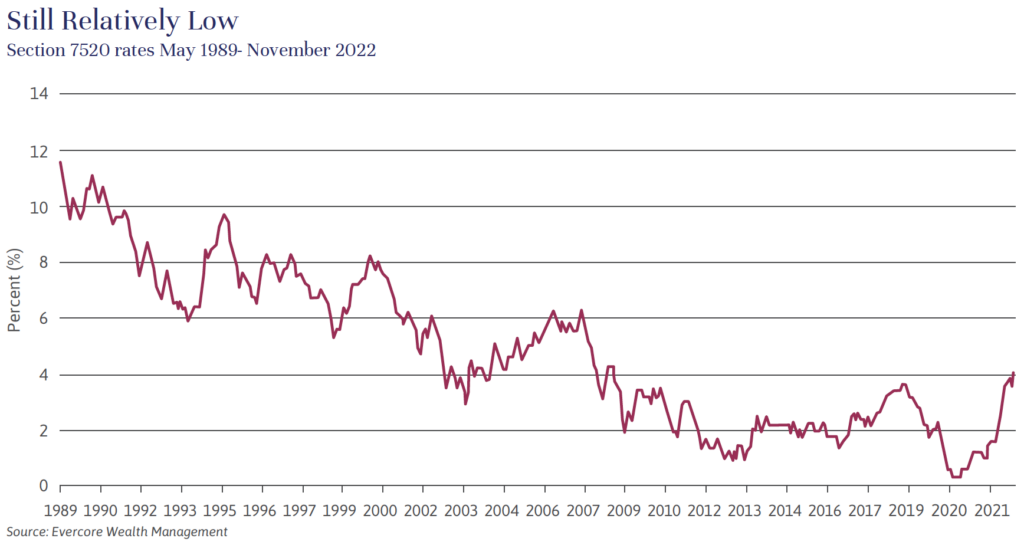
Grantor Retained Annuity Trusts, or GRATs, have been popular with high-net-worth families for years. Historically low interest rates have enabled grantors to fund trusts at the Section 7520 rate, or the hurdle rate, published monthly by the IRS, in the expectation that the funds would in fact outperform that rate and the excess appreciation be transferred to the beneficiaries free of gift and estate tax. That worked brilliantly when rates were low and markets were rising. Now families have a higher hurdle to surmount; as of November, the 7520 rate is 4.8%, up from 1% just a year ago. And the markets haven’t been helping the existing GRATs.
This is where perspective matters. Sure, rates aren’t as favorable as they were a year ago, but as illustrated by the chart below, they are still low from a longer-term perspective. As for the markets, a bear market can be a boon when funding a brand new GRAT. Once the account performance clears the hurdle rate, the GRAT beneficiaries could benefit from a subsequent market recovery. (See the diagram below for an example of a GRAT.)

A Charitable Lead Annuity Trust, or CLAT, may still be an attractive transfer strategy for families who are charitably inclined. CLATS are split-interest trusts that benefit a charity during their terms and, at the termination of the trust, allow remaining assets to pass to the remainder beneficiary, typically the heirs. As with a GRAT, the amount of the remainder will depend on whether the trust’s investments outperform the Section 7520 rate.
In a still relatively low interest rate environment and after a market dislocation, CLATs can be an effective means of wealth transfer to the next generation. The interim beneficiary of the charitable lead interest can be a donor-advised fund, a private foundation, or a public charity. If structured as a grantor trust, the grantor may have an immediate tax deduction as well. Decisions between grantor and non-grantor CLATs are based on personal circumstances and should be made with professional consultation.
Please note that both GRATs and CLATS should only be used for the transfers to the immediate next generation, not to grandchildren.
Families looking for more immediate wealth transfer solutions, say to help buy a home or start a business, may want to consider intra-family loans, especially now that mortgage and bank personal loan rates have spiked. Intra-family loans can be made using the Applicable Federal Rates (AFRs) published monthly by the IRS. At present, that could mean as much as a three-percentage point difference on a 30-year mortgage. It is important to note that the loan documents should be properly drafted, as they may otherwise be viewed by the IRS as a gift. The interest on the loan will be taxable to the lender as ordinary income.
Other estate-planning vehicles, such as Qualified Personal Residence Trusts (QPRTs) and Charitable Remainder Trusts (CRTs), will become more attractive if interest rates continue to rise. We will review these in future editions of Independent Thinking as circumstances warrant. At present, rates are still relatively low, and we continue to think that it is more likely than not that they will stay that way. (See John Apruzzese’s article titled, Orienting in a Changing Investment Landscape.)
Either way, it’s important to keep in mind that interest rates should never be the only driver in wealth transfer decisions. While giving sooner rather than later could provide significant tax benefits, as a married couple can transfer up to $24.12 million in 2022 and $25.84 million in 2023 completely free of taxes over their lifetimes until 2025, after which time the exemption amounts are roughly halved, transfer strategies should also be executed in the context of long-term plans. Families considering substantial transfers should consult their Evercore Wealth & Fiduciary Advisors to review the most appropriate planning vehicles in the context of long-term wealth plans, as well as prevailing economic and market conditions.
Making significant gifts to loved ones is arguably one of the most fraught wealth management decisions. Emotionally, we need to balance the joy of giving during our lifetimes with a potential loss of control and the prospect of unintended consequences. Practically, we need to weigh how much we can afford to give, with the realization that every dollar not transferred could be subject to a 40% federal estate tax (or more, if rates return to previous levels), as well as potential state estate taxes.
The last thing anyone wants is to have to borrow from their kids or grandkids later in life because they gave too much away. Whether you have $10 million or $100 million, a long-term cash-flow analysis – also called a lifestyle analysis – is a necessity. No one wants to be forced into significant drawdowns at the wrong time, which means that inflation and market volatility must be considered. In addition, wealthier people tend to live longer than average, and a longer life could bring unexpected and uninsurable medical expenses down the road.1
Sometimes, even those with more wealth than they would ever spend in multiple lifetimes might be afraid to give. In that case, it is important to address any anxiety from a psychological and emotional perspective, as well as from a practical one.
Some people want to know how much is enough. Other people want to learn how much is too much. Warren Buffett once said that the perfect amount to give children is “enough money so that they would feel they could do anything, but not so much that they could do nothing.”2 Unfortunately, there is no magic number.
Instead, the answer is to give loved ones no more than they are prepared for. An unprepared individual could receive a few hundred thousand dollars, and it could ruin their life – they might drop out of school, abuse drugs and alcohol, or develop a gambling addiction. On the other hand, a prepared person could be gifted millions of dollars and could still turn out well – continue to study hard, build a career, raise a family, and become a pillar of the community.
The key is to focus on preparing the family for the money. A team of good attorneys, accountants, and wealth managers should be able to help implement a successful long-term plan to invest the family’s assets and transfer the funds over multiple generations in a tax-efficient manner. The team should also focus on the work in preparing future generations for that financial wealth. This could involve financial education, communication and values exercises, and a focus on healthy family governance.
From a gift, estate, and generation-skipping transfer, or GST, tax perspective, giving sooner rather than later could provide substantial tax benefits. Not only can a married couple transfer up to $24.12 million completely free of taxes in 2022, but all the future growth of those assets could be free of any future gift, estate, and GST taxes. Moreover, the $24.12 million lifetime exemption amount per couple is set to be cut roughly in half after 2025, so families only have a relatively limited time to take advantage of the substantial potential tax savings from the larger use-it-or-lose-it exemption amount.
On the emotional front, not only do we want to see loved ones enjoy gifts while we are still alive, but studies have shown that giving to others can boost the giver’s happiness and satisfaction, increase life expectancy, reduce stress, and ease depression.3 Moreover, avoiding the topic of wealth transfer, to family members and to charity, could create more problems down the road. Even if family members currently get along, they might all end up fighting with each other over assets if they are not prepared for the wealth.
Before making any gift, it is important to prepare family members for that gift from a financial, psychological, and emotional perspective. There is not one perfect age at which to directly give money to a child or grandchild. Some young adults are perfectly equipped to manage millions of dollars in their 20s, while older adults might blow it all within a few years. The answer to when to give is only when they are ready. By starting with gifts of smaller amounts at younger ages, you can help the next generation learn to manage the wealth in an effective and healthy manner, develop greater responsibility, and become good stewards of the wealth in the future.
An individual can give to as many people as they want up to $16,000 per year – the annual exclusion amount as of 2022 – without any need to report the gift for tax purposes on a Form 709, United States Gift (and Generation-Skipping Transfer) Tax Return. In addition, individuals can pay anyone’s education or health care expenses directly without it counting toward their annual exclusion amount or lifetime exemption amount.
Making gifts to loved ones does not necessarily mean handing them cash. Instead of giving assets directly outright, gifts can be set up during the beneficiary’s lifetime for tax purposes by using trusts. In addition to tax benefits, those trusts can also be used to preserve assets as a safety net for the beneficiary’s lifetime – in other words, moderate how much is available to beneficiaries based on personal circumstances, such as supplemental income for education or consumption. Furthermore, trusts, along with the guidance and protection of a corporate trustee, could also provide beneficiaries with additional asset protection from potential creditors or even possible divorce in the future.
Setting aside gifts in trust now does not have to mean telling beneficiaries about the gift or handing them copies of account statements or balance sheets. While most states require that trust beneficiaries receive certain notices about a trust and the trust’s assets, there are some states – such as Delaware – that have special “silent trust” rules, which allow the grantor to keep information private.
Balancing equal with equitable can be a major planning challenge while trying to preserve family harmony. Differences in means and needs require each family to determine what fair means to them and what the future might hold. For example, family members with special needs may require additional financial assistance. At the same time, individuals who are financially successful now might need more support down the road due to a potential health condition or financial hardship in the future.
For many families, charity is often part of the overall wealth plan. From an income, gift, estate, and GST tax perspective, it is important to work with good advisors to structure charitable gifts in the most efficient manner for tax purposes. While a common approach is to set aside a portion of income for charity, a more recent approach among some families is to treat charity like a child when determining overall giving. For instance, a family with three children could set aside 25% for charity and the remaining 75% for the children. As discussed in the previous issue of Independent Thinking, a family philanthropy program also could be created so that generations can work together to support the family’s legacy.
Providing wealth to loved ones should truly be a gift, not simply a mechanical transfer of assets. If done correctly after preparing those loved ones for the wealth, it could provide a better quality of life, save on taxes, and prevent the negative impacts on those who are unprepared for the wealth. Consider working with your wealth advisor who can provide a financial analysis and help prepare future generations as part of an ongoing process. As Nathan Mayer Rothschild, son of the founder of the Rothschild banking dynasty, once said, “It requires a great deal of boldness and a great deal of caution to make a great fortune; and when you have got it, it requires ten times as much wit to keep it.”
Justin Miller is a Partner and National Director of Wealth Planning at Evercore Wealth Management. He can be contacted at justin.miller@evercore.com.
In the absence – yet – of new tax legislation, families face continued uncertainty regarding the future of the estate and gift tax systems. Washington could remain in deadlock on this issue, of course, but tax changes could also be back on the agenda soon, along with the possibility that they could be made retroactive to the beginning of the year. As it is, the current inflation-adjusted exemption of $12.06 million is set to recede to about $6.5 million in 2026.
That’s no reason to rush in, of course. Significant wealth transfer should always be informed by substantive discussions among family members, and with the family’s wealth and fiduciary advisors and other trusted members of their team. As Jeff Maurer writes in his article, Now What? Time to Revisit Goals, the starting point should be a thorough analysis of whether the donors can maintain their lifestyle after the gift is made. But for families who have done the planning work and are prepared to make gifts, there may be several non-tax benefits to be gained by gifting sooner rather than later (or not at all).
First, gifting now removes future appreciation from the estate. Second, it provides current creditor protection. Third, it may enable the estate to avoid state estate or inheritance taxes on the gifted assets.
As for the tax advantages, there is a considerable incentive to give as much, if not all, of the current exemption amount in this environment. Look at it this way: If you were to make a gift that used $5 million of the current $12.06 million exemption, and the exemption were to be reduced to $6 million, your remaining exemption at that time would be $1 million, putting you in no better place than if you had waited. If you used the full current exemption, the amount over $6 million and less than $12.06 million would not be subject to any clawback gift tax or estate taxation on your death if the exemption were later reduced.
There are also risks. One danger with gifting the entire exemption amount is that it leaves little margin of error should the IRS adjust the value of the gift – any increase in the valuation will be subject to an immediate 40% gift tax.
An IRS adjustment is generally not an issue with easy-to-value assets, such as cash, marketable securities, or U.S. treasuries; there are very clear valuation guidelines for those assets (for example, publicly traded securities are simply valued at the average of opening and closing values on date of gift), which leaves little room for an IRS challenge.
Assets without a readily available market price must comply with the amorphous “willing buyer and willing seller” test. Even with a comprehensive appraisal performed by an experienced appraiser, there is always a risk that the IRS will challenge the valuation, particularly if discounts for lack of marketability or control are being used. Also, if the gift fully utilizes the exemption, then the IRS has the added incentive of an immediate payday if it is successful in challenging the valuation.
The easiest solution to the problem of revaluation would be to gift only easy-to-value liquid assets. However, transferring closely held businesses, real estate or art often provides the best opportunities for valuations that allow the donor to take advantage of common discount techniques and also allow liquid assets to be earmarked for living expenses.
The best way to deal with this dilemma is to use the “defined value” or “formula” gift approach, which allows the taxpayer to maximize usage of the available exemption while providing safeguards against revaluation. Formulas have been commonplace in estate planning documents for as long as there has been an estate tax exemption; for example, to calculate the proper funding of marital and credit shelter trusts. Historically, courts placed strict limitations on the formula approach for gifting that limited its utility. That started changing about 10 years ago, when a series of court cases upheld the use of defined value clauses and laid a framework for their successful use. It’s important to note that, while this approach has become more commonplace, it may still be subject to IRS scrutiny.
There are two primary approaches to formula gifting. The first, more conservative approach is to direct any excess valuation to a beneficiary that would not trigger gift tax. The safest option would be a charitable beneficiary, as that strategy has been approved by the courts and is supported by the general public policy toward charitable giving. However, if donors don’t have the requisite charitable intent and a specific charity in mind, then this approach may generate less in benefits than simply paying the gift tax. In the absence of a specific charitable intent, another option would be to have the excess pass to a marital trust or an incomplete gift trust. That strategy has not been fully tested by the courts.
The second, more aggressive approach simply ties the transferred percentage of the gifted assets to the dollar value of such interest as finally determined for gift tax purposes. This is considered somewhat aggressive because the IRS chose not to acquiesce to the court decisions approving this structure. Still, it is the most efficient approach, as it does not require use of an alternate for any excess valuation, meaning that the assets go exactly where you want them to go, with no waste.
In either case, it is important that the gift instrument clearly articulates the specific intent and ties the value of the gift directly to the value “as finally determined for gift tax purposes.” An IRS revaluation for gift tax purposes does not automatically trigger an adjustment under the gift documents if that specific language is not included. It is also important that the characterization of the gift as representing a dollar value rather than a percentage of interest be carried through to the description of the gift in the gift tax return so that there is no ambiguity.
In the current environment of historically high estate and gift tax exemptions combined with the constant threat of dramatic reductions thereto, there is strong incentive to make gifts as close as possible to the current maximum exemption amount. While cash and marketable securities can be gifted in definite dollar amounts, gifts of hard-to-value assets carry the risk that the IRS will seek to revalue those assets, potentially triggering a gift tax liability. In this regard, the “defined value” or “formula” gifting approach offers an interesting mechanism to maximize the use of the current exemption amount while providing a hedge against IRS valuation challenges.

Alex Lyden-Horn is a Managing Director and Director of Delaware Trust Services and Trust Counsel at Evercore Trust Company, N.A. He can be contacted at alexander.lydenhorn@evercore.com.
In preparing the next generation of young children and grandchildren to be happy and productive members of society, we believe that one of the single best activities to consider is family philanthropy. For parents and grandparents looking to transfer values to future generations and create a lasting legacy, family philanthropy can’t be beat.
The benefits of philanthropy are extraordinary and well documented. Giving can boost happiness and satisfaction, increase life expectancy, reduce stress, and ease depression.1 For children, philanthropy can be especially impactful. By engaging in charitable activities, children experience increased well-being, popularity, and acceptance among peers, which leads to better classroom behavior and higher academic achievement.2
Family philanthropy is about giving together as a family. Collective, communal, and cooperative giving helps solidify family values. Through making gifting decisions as a family, younger family members can develop a wide variety of skills, including communication, negotiation, shared decision-making, leadership, accountability, investing, financial literacy, and responsibility to help others. As an added benefit, family philanthropy teaches the same skills that are necessary to prepare the younger generation to manage and expand the family’s wealth in the future.
Family philanthropy is not only accessible to the wealthiest families with private foundations. Even for families without private foundations, a donor-advised fund, or DAF, could serve as a great cost-efficient resource for parents or grandparents to begin family philanthropy programs for younger members of their families. Because DAFs typically offer user-friendly online platforms without the expense and administrative burdens of a private foundation, they are often the ideal charitable vehicle to help the younger generation become a part of a family philanthropy program.
Before engaging in family philanthropy, it’s important for the elder generation to first facilitate a family meeting, which should include a meaningful discussion about philanthropy with the entire family – ideally, one where each member of the family proactively participates. Research has shown that conversations between parents and children about charity have an even greater positive impact on children than parents serving as silent role models through their own philanthropic activity.3 With the additional help of a neutral professional facilitator, this family meeting also could benefit from the inclusion of effective communication exercises, as well as the use of tools to help the family members discover their common values and vision.
Children can become part of a family philanthropy program at as young as five years old and can begin to play a deeper role with respect to the actual administration and investments of the family philanthropy program before they’re teenagers. Family members may wish to set standards for performance to accompany each grant given as part of the family philanthropy program, and selected charities that attain those standards might be allocated more funds in future years. The children can propose – and advocate for – a grant request, which could include site visits to the proposed grantee and interviews. A family philanthropy program could even require each participant to make some type of personal investment in any organization that will be receiving funds – such as actively volunteering with the organization or making a small personal gift along with the larger donation from the family philanthropy program.
As part of the family philanthropy program, each family member could be given a relatively small amount to donate to charity independently. In addition, a separate larger amount may be set aside for all the family members (for example, siblings or cousins) to give away as a collective unit – so that they will be required to discuss and agree together on the organization receiving the donation. Many organizations encourage children’s participation in philanthropic activities and welcome the younger members to visit their facilities and even volunteer – often a terrific way to unite family members as they work together toward a common goal. For more substantial donations, particularly ones in which the family name will be recognized, involving the whole family can help instill a sense of pride in the family legacy. So long as the elder generation does not assert too much oversight or control over the program, family philanthropy typically is an extremely positive experience for the younger generation.
Consider the experience of a married couple with three children, ages 11, 13 and 18. They provide $1,000 annually to each of their children to give away on their own. They also set aside $5,000 annually for their children to give away together. The couple allows their children to explore their own passions and helps facilitate the group discussion to accommodate the different age ranges of their children and their different communication styles. In the first year, after visiting and volunteering at multiple charitable organizations, the 11-year-old and 13-year-old give their $1,000 to a local animal shelter, and the 17-year-old decides to give his $1,000 to a micro-lending organization.
As a collective gift, the three children discuss the family’s values and vision with their parents and decide to give the entire $5,000 to a cancer research organization, in the name of their grandfather who had died in his early 50s from cancer. For the upcoming year, the couple allows their three children to decide how to invest the $8,000 in annual funds for the family philanthropy program. If the investments do well, they will have more to give away; but if they take too much risk and make bad investment decisions, they will have less to give away. It’s a real-life lesson, administered with care.
The right giving approach is different for each family. Ultimately, however, family philanthropy helps younger family members learn both independence (how to be self-sufficient and self-supporting) and interdependence (how to be emotionally, economically, ecologically, and morally responsible to other family members). With such an overwhelmingly positive impact, we believe that family philanthropy should be a top consideration for every family beginning a journey toward healthy governance.
When it comes to that first family meeting, a good place to start is by asking each member of the family to address the following very specific who, what, when, where, why and how questions:
To maintain a strong family philanthropy program over time, the program should have the following four components:
Justin Miller is a Partner and National Director of Wealth Planning at Evercore Wealth Management. He can be contacted at justin.miller@evercore.com.
If we can’t take a treasured possession with us, we might want to ensure that it’s taken care of. hat’s true for all sorts of assets, whether a beloved family vacation home, an art collection, a pet, or even our own cryogenically frozen remains or other genetic material. (The verdict is still out on whether we can, in fact, take the last with us.)
A non-charitable purpose trust can serve as a steward of certain valued assets, protecting them for years to come or even in perpetuity. Once the sole province of offshore jurisdictions, the non-charitable purpose trust is now permitted in some form in almost every state.
Unlike other trusts, a non-charitable purpose trust is designed to carry out a specific purpose, rather than benefit certain named beneficiaries. As illustrated by the charts below, non-charitable purpose trusts have a wide range of potential applications.*
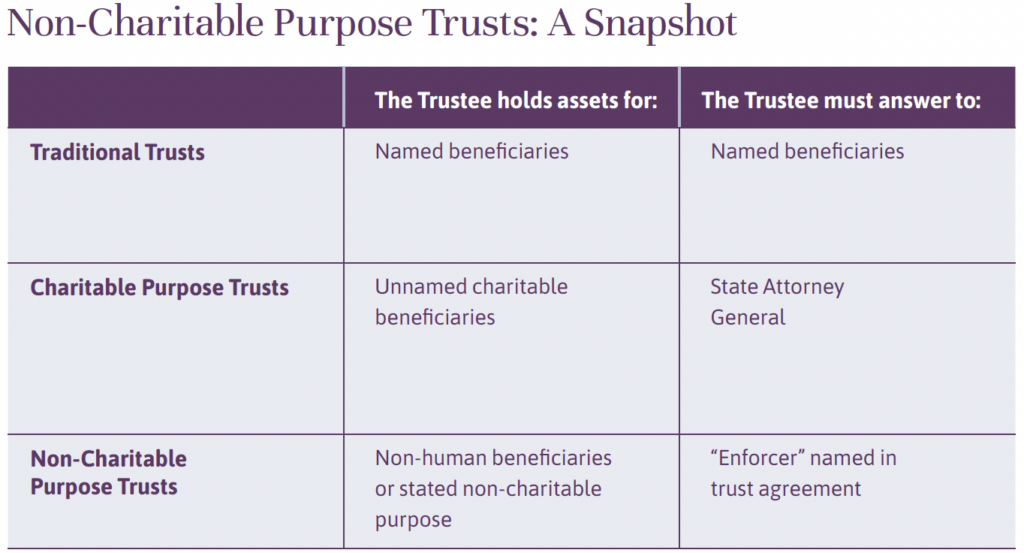
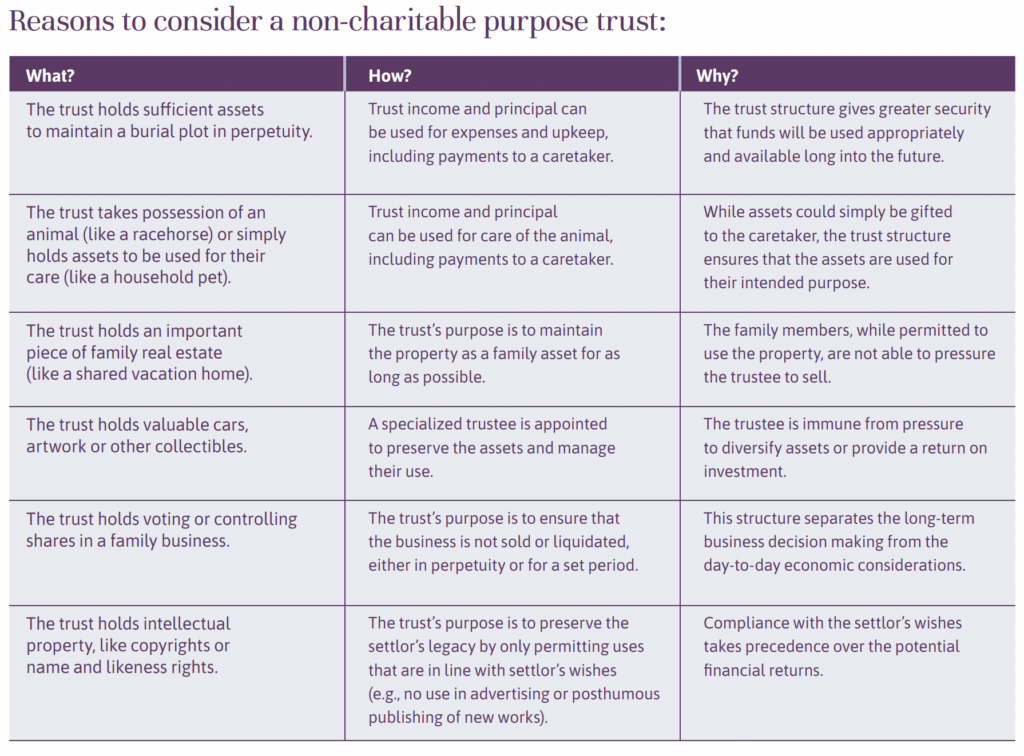
There have historically been two primary uses for non-charitable purpose trusts (which were sometimes referred to as “honorary” trusts). The first use is the care and maintenance of a burial plot. This structure could theoretically be applied to the maintenance of cryogenically frozen remains or other genetic material, but that is still up for debate. The second is the care of pets or other animals after the death of the owner. Depending on the maximum term under state law, such trusts may be structured to continue in perpetuity for the benefit of both the named animals and their future offspring.
An increasingly popular and evolving use of non-charitable purpose trusts is to hold an asset that has particular meaning or importance to the settlor. The advantage of this structure over a traditional trust is that the focus will be on the best interests of the asset itself, rather than investment performance or the wishes of individual beneficiaries. These are often described as stewardship trusts, as the primary purpose is the preservation of the asset in accordance with the settlor’s wishes and values.
All of these trusts can also be structured to distribute out to named beneficiaries, whether individuals or charities, or be held in further trust for their benefit, upon the completion of the purpose.
So, who ensures that the settlor’s wishes are carried out when there are no beneficiaries? For trusts with a traditional charitable purpose, the State Attorney General in each jurisdiction is empowered to step in; that’s not the case with non-charitable purpose trusts. Enter the “Enforcer,” who, as the title suggests, is named in the trust agreement to enforce its terms and hold the trustee accountable.
The flexibility of a non-charitable purpose trust depends largely on the state where the trust is established, meaning that choice of situs is critical. States with more traditional laws may permit non-charitable purpose trusts only in very specific circumstances; for example, the care of animals or the maintenance of gravesites as discussed above. Such states may also limit the maximum term to as little as 21 years. However, some states, including Delaware, permit trusts for any lawful purpose that is reasonable, attainable, and does not violate public policy, and these states have statutes expressly permitting such trusts to exist in perpetuity.
The longer the term of the trust, the more likely it is that there will be a material change in circumstances affecting the fulfillment of the purpose. Therefore, for a long-term or perpetual trust, it may be advisable to appoint a trust protector with broad powers to, for example, modify the purpose, add beneficiaries or terminate the trust. This strategy can be combined with directed trust statutes to further customize and allocate the powers under the trust, which is particularly beneficial if the trust holds unique assets that require specific skills to manage.
Given the specialized nature and near-limitless options for non-charitable purpose trusts, the choice of fiduciary is also a critical decision. In some instances, the best option may be to have a trusted individual serve as the decision maker with respect to the purpose, with a corporate trustee in place to handle the administrative functions (and also grant access to the preferred jurisdiction). On the other hand, the trust will likely need to hold sufficient investable assets (in addition to any “special” assets) to ensure that the purpose can be maintained for the expected term of the trust. Responsibility for such assets may be better allocated to a corporate fiduciary or professional investment manager. Fortunately, the states that permit long-term non-charitable purpose trusts also tend to have robust directed trust statutes that permit this level of customization.
As to tax, non-charitable purpose trusts are generally subject to the same tax systems as traditional trusts. However, it is important to note that, from a tax perspective, non-charitable purpose trusts have more in common with traditional irrevocable trusts than charitable trusts.
For income tax purposes, like traditional trusts, non-charitable purpose trusts can be structured as grantor trusts (income is taxed to the grantor/settlor) or non-grantor trusts (income is taxed to the trust). The grantor trust structure is the most straightforward, at least while the settlor is living, as all income simply passes through the trust and is reported on the settlor’s income tax return.
Similarly, for gift tax purposes, despite the absence of identifiable recipients, contributions to a non-charitable purpose trust are considered gifts to the same extent as contributions to a traditional trust. Thus, like traditional trusts, a non-charitable purpose trust can be structured as a completed gift or an incomplete gift. However, gifts to a non-charitable purpose trust typically will not qualify for the annual exclusion from gift tax, because there are no individual beneficiaries to possess withdrawal rights (often referred to as “Crummey Powers”). Also, unlike a charitable trust, the initial funding of the trust would not qualify for the charitable deduction.
Finally, while it may seem unlikely that a trust without beneficiaries would create any generation-skipping transfer (“GST”) tax concerns, it is important that a full GST review be performed. For example, there may be a need to allocate GST exemption to the trust if there is a possibility that the assets will pass to grandchildren or to more remote descendants once the purpose has been completed.
A non-charitable purpose trust is a unique estate planning structure that may not be appropriate for everyone. However, for those with a need to care for animals or to preserve unique assets, or to further causes that do not fit into the traditional charitable trust mold, they present a powerful and flexible tool. While the focus of traditional estate planning tends to be on tax savings, asset growth, and efficient transfers of wealth, the non-charitable purpose trust is focused on ensuring that one’s wishes are carried out, taking into account one’s values and priorities, without diminution by economic or beneficiary concerns. In this regard, they should be considered a valuable complement to the more traditional estate planning structures.
Alex Lyden-Horn is a Managing Director and Director of Delaware Trust Services and Trust Counsel at Evercore Trust Company, N.A. He can be contacted at alexander.lydenhorn@evercore.com.
When it comes to estate planning, the best advice is to plan early and often. Not only are the current estate and gift tax rules set to expire after 2025, but, depending on Congress, we could see some significant changes much sooner. Families looking to pass on intergenerational wealth in the most tax-efficient manner should consider taking action as soon as possible.
The proposed changes are significant. Following a 1,633% rise in the estate tax exemption over the past 20 years, President Biden earlier this year proposed multiple tax changes as part of the American Families Plan. More recently, the House Ways and Means Committee, the chief tax-writing committee of the House of Representatives, proposed to cut the estate tax exemption roughly in half, subject grantor trusts to estate taxes, and eliminate tax-free sales to intentionally defective grantor trusts.
Each individual currently has an $11.7 million exemption amount, which means a married couple can give $23.4 million to loved ones during life or after death without owing any gift, estate or generation-skipping transfer, or GST, tax. That exemption amount is a use-it-or lose-it benefit, so if the exemption amount goes down in the future, any prior gifts will receive grandfathered protection. The Treasury Department issued final regulations in 2019 confirming that there will be no so-called clawback for tax purposes if an individual makes a tax-free gift under the current law and the government reduces the exemption amount in a future year.
The other change that could occur is an increase in the gift, estate and GST tax rate, which currently is 40 percent. From a historical perspective, the highest rates ranged from 55% to 77% for almost 70 years before 2002. Therefore, not only could the exemption amount be reduced, but the gift, estate and GST tax rate also could be significantly increased in the future.
Given the potential reduction in the exemption amount and possible increase in tax rates, there is a narrow window of opportunity remaining in 2021 for families to transfer substantial wealth to future generations permanently free of gift, estate and GST tax. Let’s look here at three planning strategies that can affect this transfer, keeping in mind that any big decision should be made in the context of each family’s long-term wealth plan and in close consultation with advisors.
One of the most popular wealth transfer strategies is to create a Dynasty Trust in Delaware or in other states with strong asset protection laws, for children, grandchildren and future generations.
A Dynasty Trust could not only prevent future gift, estate and GST tax, but could also help protect assets for family members from future creditors in the wake of any number of potential events, such as a car accident or divorce. For instance, a married couple could transfer $23.4 million tax-free into a Dynasty Trust. Those assets and all the future growth would be permanently set aside for family members without ever being subject to gift, estate or GST tax.
As an example of the potential future benefit provided by Dynasty Trusts, a $23.4 million Dynasty Trust growing at 7% per year would set aside potentially $176 million in 30 years for future generations free of gift, estate and GST tax. Moreover, Delaware eliminated the common-law rule against perpetuities in 1995, which means the Dynasty Trust can support multiple generations of a family for hundreds of years.
Dynasty Trusts are often set up as grantor trusts, allowing the grantor to pay all the income tax for the trust without any gift tax consequences. In other words, the Dynasty Trust’s assets grow free of income tax, and the payment of income tax by the grantor further reduces the grantor’s taxable estate.1 On the other hand, wealthy families in high income tax states may want to consider creating a non-grantor trust, where the trust pays its own tax, in a jurisdiction where the Dynasty Trust would not be subject to any state income tax. As a non-grantor trust in a state without a state income tax, the Dynasty Trust could continue to grow free of estate, gift and GST tax, as well as state income tax for generations – subject to potential state sourcing rules and throwback tax, for example, in California and New York.
Not all wealthy parents are comfortable permanently setting aside millions of dollars for children and future generations, especially if they might need or want the assets back in the future. In that case, a spousal lifetime access trust, or SLAT, could be the optimal solution to maximize the gift, estate and GST tax savings while still protecting assets for the spouses for the rest of their lifetimes. With a SLAT, one spouse would create an $11.7 million irrevocable trust with their separate property to benefit the second spouse. After the second spouse dies, the SLAT protects future generations, free of gift, estate and GST tax. It is important to remember that SLATs are irrevocable trusts, which could be a big issue if spouses get divorced in the future.
It may also be possible for the second spouse to create a similar $11.7 million SLAT for the first spouse. However, the two SLATs would need to be independent and different enough to avoid what is known as the “reciprocal trust doctrine” and “step transaction doctrine.” Accordingly, the first spouse is taking a real risk that the second spouse might not necessarily fund a second SLAT for the first spouse. Suppose there is concern about the reciprocal trust or step transaction doctrine. In that case, instead of the second spouse creating a similar SLAT for the first spouse, another option could be for the second spouse to utilize their individual $11.7 million exemption by creating an entirely different type of trust, such as a Dynasty Trust, for future generations.
Typically, SLATs are grantor trusts, similar to Dynasty Trusts. As an alternative, careful drafting may make it possible to create a spousal lifetime access non-grantor trust, or SLANT. As a non-grantor trust, the SLANT would grow free of state income tax in a jurisdiction such as Delaware, subject to potential state sourcing rules and throwback tax, for example, in California and New York.
Families looking to maximize the amount they can leave to future generations free of gift, estate and GST tax can consider several strategies that maximize use of the current high exemption amounts. A sale to an intentionally defective grantor trust, or IDGT, which could be a Dynasty Trust or SLAT, is one of the most powerful strategies to set aside substantial amounts of assets for future generations. Typically, the first step is to fund the IDGT with an amount equal to 10% of the assets that the IDGT will be acquiring. The initial gift is often referred to as seeding the trust, although some practitioners are comfortable eliminating this step if there are adequate beneficiary guarantees.
For example, a married couple who are parents could gift $23.4 million to an IDGT, and the IDGT would then buy $234 million worth of assets from the parents for a promissory note. The IRS publishes applicable federal rates monthly; the minimum interest-only payment that the parents would need to charge on a promissory note for 30 years would be 1.73%.2 To make the sale to IDGT strategy even more effective, wealthy families often sell assets, such as closely held business interests, to the IDGT at a discount due to their lack of marketability and control.3 For example, families could create a family limited partnership, or FLP, or a family LLC to manage the family’s investments. It is essential that the entity has a legitimate business purpose and that the family respects both the form and substance of the structure.4
Of course, the government could eliminate discounts for family-controlled entities in the near future – which has been proposed by the House Ways and Means Committee – so there might be limited time to transfer discounted interests in a family-controlled entity before the rules change. The Treasury Department issued proposed regulations under section 2704(b) in 2016, which would have limited the ability of families to claim valuation discounts for gifts and bequests of interests in family-controlled entities to family members. However, in response to President Trump’s Executive Order 13789 in 2017, the Treasury withdrew those proposed regulations. With the change in presidency and political shift in Congress, intrafamily discounts once again could be a target for change.
As an example of the substantial amount of assets that parents can transfer to future generations with a sale to IDGT strategy, let’s assume two wealthy parents create an FLP. The parents could then seed an IDGT with $23.4 million and sell a $234 million discounted limited partnership interest to the IDGT. Assuming a 35% aggregate discount for lack of marketability and control, that $234 million discounted limited partnership could have an undiscounted value of $360 million. The IDGT could purchase the interests from the parents with a $234 million interest-only promissory note using, for example, the September 2021 IRS section 7520 interest rate of 1.73% for 30 years. The IDGT is a grantor trust, so the parents would not owe any income tax on the sale, as the tax rules do not treat it as a sale for income tax purposes.5 If the assets grow at an illustrative 7% rate for the next 30 years, the partnership liquidates, and then the note is paid off, there will be potentially approximately $2.3 billion in the IDGT for future generations that could be permanently free of gift, estate and GST tax. If future estate tax rates eventually go back to the historical norm of 55%, planning in 2021 would save the family almost $1.3 billion in tax.
Every family has unique characteristics and dynamics, and again, any plan should reflect the collaborative counsel of advisors, including a wealth manager, attorney and accountant. A professional appraiser also should be included to value assets other than cash or publicly traded securities. And don’t forget to file Form 709, United States Gift (and Generation-Skipping Transfer) Tax Return, to report any gifts that take advantage of the exemption amount.
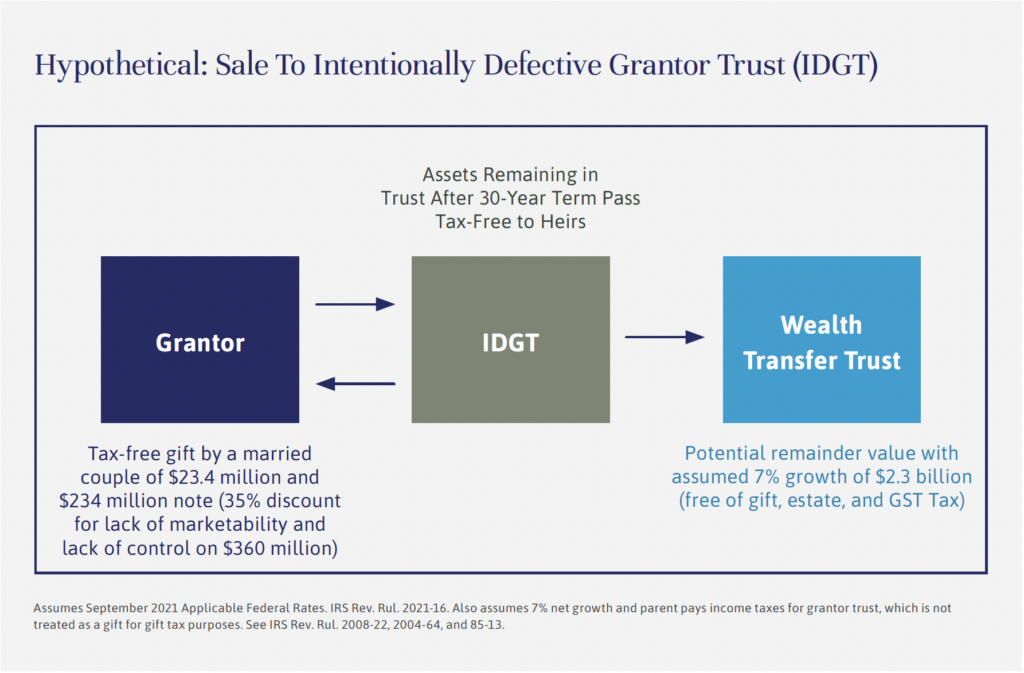
Justin Miller is a Partner and National Director of Wealth Planning at Evercore Wealth Management. He can be contacted at justin.miller@evercore.com.
Editor’s note: Evercore Wealth Management supplements its core investment capabilities with carefully selected outside funds across the range of the firm’s asset classes. Here we discuss opportunities in public companies with Debra Netschert, a health sciences equity portfolio manager at Jennison Associates. Jennison employs a bottom-up, analyst-driven stock selection based on proprietary fundamental research and investment insight. Please note that this article represents the views of Jennison and not necessarily the views of Evercore Wealth Management.
Q: Debra, let’s start with the pandemic. Is it as transformative to the global health sciences sector as many investors might suspect?
A: It does feel like all COVID, all the time. And it is clear that healthcare is going to change in a dramatic way as a result of this experience. We are going to see faster product rollouts, faster development times and far more user engagement. As a society, we’ve become so much more technology savvy and so much more health savvy. That’s a powerful combination.
Q: So, you anticipate more consumer demand?
A: People everywhere are thinking much more about their healthcare and are conscious of the things that they can do to help themselves, including through the use of personal care devices. Sure, maybe some of the self-administrated blood oxygen measurements and thermometers that we’ve all been buying will get tossed into drawers. But it seems inevitable that people are going to increase their efforts to optimize their healthcare. And technology is going to play a big role there.
Q: What sorts of new products are you excited about?
A: Think about glucose monitors that provide a continuous glucose monitoring system (CGM). The daily management of diabetes is daunting, and achieving clinically acceptable outcomes requires significant engagement and modified behavior. The availability of actionable data – such as real-time accurate blood glucose readings – is the first and arguably most critical piece of diabetes treatment algorithms. We are excited about next-generation CGMs, which will have a smaller footprint and increased accuracy. A growing awareness of the direct correlation between the use of real-time glucose data to positive outcomes and fewer complications will drive increased penetration into the large Type 2 population. Ultimately, individuals will have the ability to use CGMs that are more accurate, super user-friendly and about the size of a large Band-AidTM. Given that so much of disease control is about personal compliance, developments like this are going to be a game changer. Patients – and their doctors – will be able to look at their real-time data in a more qualitative fashion and make more immediate changes when needed. This will lead to much better outcomes and fewer complications.
Another innovation that has the potential to really accelerate the diagnosis of a disease and more accurately monitor disease progression is liquid biopsy. Using this technology, oncologists use a simple blood sample to figure out the driving mutation that is causing the cancer cells to multiply, instead of an invasive needle biopsy. This allows a patient to receive a more targeted therapy faster, which will hopefully lead to better outcomes.
Q: Does this surge in innovation create opportunities for skilled investment managers, especially given the relative lack of correlation of the biotech sector to the broader market?
A: Yes, because the healthcare market is very different in each geography. In the United States especially, it’s quite fragmented. In addition, diseases are heterogeneous; everyone’s body is different, and each technology being developed is slightly different from the next. These small changes are not evident on the surface; they require a skilled eye to decipher. There are countless ways to participate in this market, to find a niche, especially as the science is changing so rapidly. In the biotech sector alone, the number of public companies has more than quadrupled over the past 10 years. As for correlation, certain companies may be correlated to the market at the factor or macro level, but it is their product cycle or clinical data that will really break that correlation. We are really focused at the innovation level, looking for companies that are raising the standard of medicine across specific areas. There is a lot of clinical data to analyze in our space, and it needs to be put into context with the competing technologies, standard of care, and an ever-changing regulatory and reimbursement environment, so the bar is always moving. When the data for a clinical trial comes out, it’s never entirely in line with expectations, so we are always learning something new. Importantly, the deep analysis that comes with analyzing thousands of clinical trials helps to develop a certain level of pattern recognition, which improves your hit rate over time. We are also engaged with our management teams trying to guide them and have a positive impact on these companies, from both a strategic and ESG perspective.
Q: You sound pretty passionate about this industry. You started your own career as biotechnology analyst after an education in health science and physical therapy. What drew you to the investing world?
A: I have always had an interest in healthcare, particularly in personalized medicine, and in advancing healthcare – and I never want to stop learning. Investing in this space is a great vantage point for seeing the innovation curve, which is just so striking now. Millennials are not going to endure the healthcare system that we have today – the lack of information and lack of transparency. There is likely going to be massive change. It’s an incredibly exciting time.
For further information on Jennison and the other externally managed funds on the Evercore platform, please contact Evercore Wealth Management Partner and Portfolio Manager Stephanie Hackett at stephanie.hackett@evercore.com.
Taxes, always inevitable, now seem to be heading inevitably higher. President Biden has proposed more than a dozen significant changes in federal tax laws. Here is a brief summary of the proposed tax changes that may affect high-income/high net worth individuals and families.
While they are far from certain, given the current political landscape, they remind us how quickly the wealth planning environment can change. Any decisions should make sense in the bigger picture of long-term plans.
American Jobs Plan (the Made in America Tax Plan): The plan proposes as much as $2.3 trillion to fund infrastructure investments and spending on other priorities, such as public housing, energy efficiency, education and economic development. It also proposes hiking corporate income taxes to 28% from 21%, and changing U.S. international tax rules to boost revenues from the foreign earnings of U.S. corporations.
American Families Plan: This $1.8 trillion plan to fund college education, universal preschool, childcare, paid leave, and support low- and middle-income families would include some tax relief by making permanent certain tax credits. This would be partially funded by taxing the better off, with proposals including the following (effective January 1, 2022 unless otherwise noted):
In this very uncertain planning environment, we suggest you discuss the following with your advisors if applicable:
In addition, although changes in estate tax and estate plan legislation is not contemplated by the budget proposal, we continue to recommend that you:
Most important, don’t act precipitously. We don’t know what the final legislation will include, and tax laws change all the time. President Biden will have difficulty passing any increases in taxes, particularly individual taxes, and it seems likely that his $6 trillion budget will incur some drastic reductions. Any wealth-planning decisions in anticipation of tax changes should be made in the context of your broader financial goals.
The Biden Administration’s majority in both the House and the Senate, while slim, could result in tax legislation aimed at high net worth individuals and at corporations. Negotiations will require compromise and perhaps budget reconciliation, which allows passage with just a simple majority. Other priorities, such as managing the COVID-19 response and Cabinet appointments, will probably take time. But President Biden’s message is clear, and planning now for a progressive tax code is prudent. President Biden’s proposals, as illustrated below, include raising taxes on taxpayers making more than $400,000 and expanding Social Security tax on earned income over $400,000. For individuals, the highest marginal tax rate would rise to 39.6% from 37% at present.
And for taxpayers with over $1 million in income, capital gains and qualified dividends could be subject to ordinary income tax rates, in addition to the current 3.8% net investment income tax. This would equate to a federal tax rate of 40.8% as compared to 23.8% currently.
The Administration has also proposed doing away with the popular 1031 like-kind exchange, which for almost 100 years has allowed taxpayers to defer capital gains tax on the sale of property held in a trade or business or held for investment if the proceeds were reinvested in a similar property. Examples include land, residential, commercial and rental properties.
Other proposals include capping itemized deductions at 28% and restoring the Pease limitation, which applies a 3% reduction of some deductions based on excess income over certain income thresholds. Repeal of the $10,000 SALT cap (deduction for state and local tax) has also been proposed, which could be beneficial for some taxpayers, if they are not also subject to the alternative minimum tax.
Income tax planning in a time of flux can be tricky. Acceleration of income to avoid potential future higher rates can backfire, and we believe investments in securities as well as a business or real estate should only be sold in the context of broader investment considerations. Tax-deferral strategies such as maximizing retirement plan funding and deferred compensation continue to make sense in this environment. For property sales, accelerating a 1031 like-kind exchange could be prudent, and using the installment sale method would allow for tax deferral. Further, if charitably inclined, charitable remainder trusts, or CRTs, provide stock diversification with gain recognition over a term of years while providing a stream of income for the duration of the trust as well as an upfront charitable deduction. Finally, a disciplined tax loss harvesting approach could offset gains.
Estate plans should also be reviewed now. President Biden has indicated his support for returning the estate, gift and generation-skipping transfer, or GST, exemptions to the levels in place before the Tax Cuts and Jobs Act of 2017, or TCJA. The top tax rate could increase to 45% from 40%; the gift exemption could be limited to $1 million; and the estate and GST exemptions could be reduced to either $3.5 or $5 million, adjusted for inflation, down significantly from the current exemption of $11.7 million per person. The Biden plan would also eliminate the step-up in basis at death, although it’s not yet clear whether the tax on the unrealized gain would be due at death or when an heir later sells the asset. However, previous attempts to eliminate the basis step-up have been ultimately unsuccessful.
Anyone who wishes to utilize their remaining estate, gift and GST exemptions before the TCJA sunsets at the end of 2025, or new legislation reduces the levels, should consider accelerating planning now, focusing on certain strategies in particular. Spousal Limited Access Trusts, or SLATs, can utilize exemptions while providing support to a spouse if needed. Grantor Retained Annuity Trusts, or GRATs, are also attractive, especially in this low interest rate environment, as are strategies that freeze gift values or take advantage of discounts. And, as always, we believe that taking advantage of the $15,000 annual exclusion gift and the gift exclusion for payment of qualified medical and education expenses makes good sense. If appropriate, consider using the larger generation-skipping transfer tax exemption amount to fund Dynasty or “Perpetual” Trusts in favorable jurisdictions like Delaware.
So plan now, and thoughtfully consider implementation. Of course, any aggressive gifting plans should never come at the expense of lifestyle funds, a healthy sense of control over your own affairs and/or family legacy objectives. Your Evercore team will be pleased to help you model likely outcomes and incorporate proper governance preparing for change.
Pam Lundell is a Partner and Wealth & Fiduciary Advisor at Evercore Wealth Management in Minneapolis. She can be contacted at pamela.lundell@evercore.com.
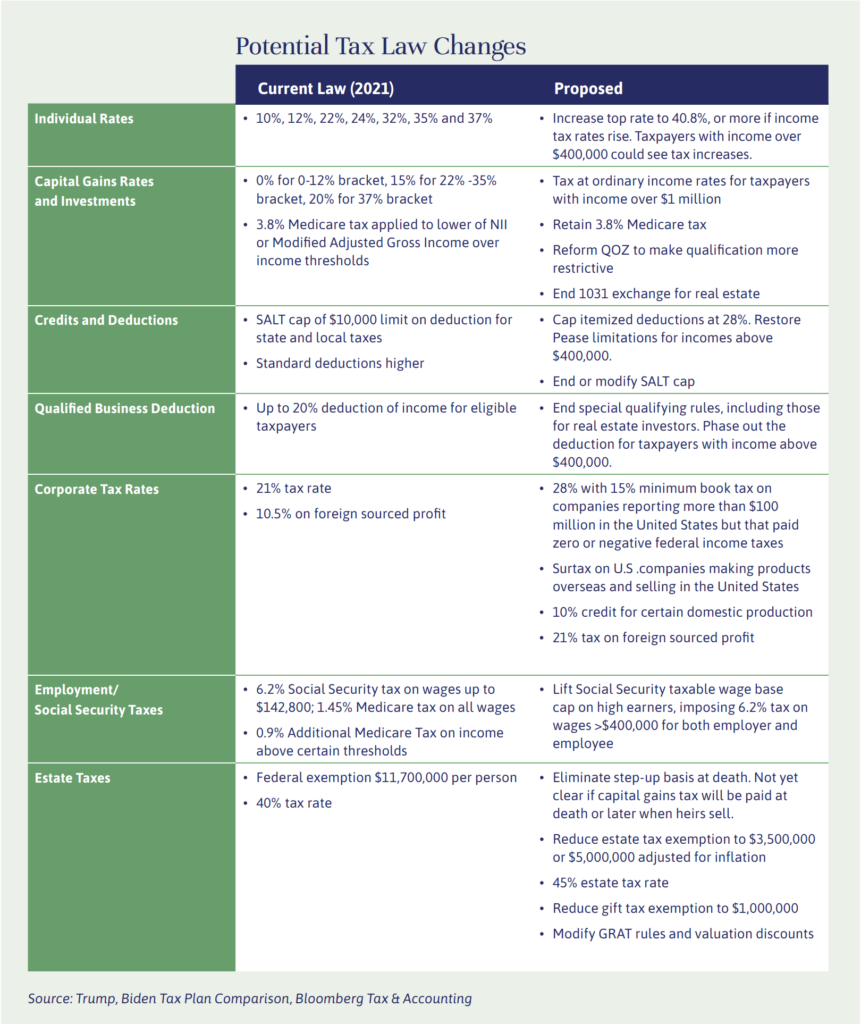
Business founder-owners are often so focused on managing their businesses that they struggle to prepare for the eventual transition, both on the business front, as described here and in an article by Evercore Senior Managing Director Jason Sobol, and on the personal level. Assembling the right team can ease that burden, ensuring the best possible deal and opening up vistas in the next stage of life.
Pre-transaction
Post-transaction
Ashley Ferriello is a Partner and Wealth & Fiduciary Advisor at Evercore Wealth Management and Evercore Trust Company. She can be contacted at ferriello@evercore.com.
Editor’s note: Jason Sobol is a Senior Managing Director of Media and Information Investment Banking at Evercore and the Co-Head of U.S. Advisory. He focuses on advising companies in the information and media sectors, and in the past year he has advised Clarivate on its merger with CPA Global, IXL Learning on its acquisition of Rosetta Stone, Red Ventures on its acquisition of CNET, RetailMeNot on its sale to J2 Global, and Comscore on its equity raise from Charter Communications,
Q: Jason, many of our readers have built businesses of their own, not dissimilar from the many founder-owned businesses in your industry sector. How would you suggest that they think about an eventual exit?
A: The right time to sell a business to maximize value is when the stars align around four primary factors: market conditions, industry dynamics, buyer strength, and business momentum. Obviously, we spend a lot of time discussing the first three with our clients, but those are out of our clients’ control. The business trajectory is in a company’s control and is a key determinant to optimizing when a business enters a potential sale transaction process.
The design of that process should be customized to the particular objectives of the founder-owner. Typically, most owners want to maximize value, speed of process and certainty of transaction closing. With family founder-owned businesses, we also appreciate the importance of legacy as an additional objective, which can have its own intrinsic value to a family-founder, and can influence both the optimal timing of a transaction and the process structure itself.
Q: What do you mean by legacy in this context?
A: For founder-owned businesses, legacy can include estate planning, employee protections, political, succession objectives or other considerations (the founder may have preferred buyers in mind, for example); a whole set of objectives beyond the dollars. For example, let’s take succession: Many founders wait until they feel done – ready to sell and completely retire. If that founder is also an active CEO, any buyer paying a premium value for the business is probably going to expect the founder to have some “roll and role” – reinvesting equity into the transaction and also sticking around in some capacity for a period of time for an orderly succession transition. Founders should take such considerations into account when optimizing the timing of a sale process.
Founders may have a bias to certain strategic acquirers as the perfect home for their business, customers and employees. This criteria may warrant a customized process that engages with certain strategic buyers sequentially versus simultaneously with other financial and strategic acquirers.
As a result, legacy and founder-specific objectives have profound implications on both the timing and structure of a transaction process.
Q: Does that mean founders often leave business transaction planning too late?
A: Correct. It takes planning well in advance to optimize the outcome. That’s why we are always talking to founder-owners about where they are in their succession curve, as well as helping them understand the market dynamics and sensitivities of potential buyers. If a founder-CEO wants to completely exit the business, such a business owner should either execute the succession plans well in advance of a transaction or prepare to do so for some period of time after a transaction. Leaving that risk to a buyer could have profound implications on the achievable value for the business.
These can be hard conversations, but the interplay between process timing and valuation is important. We really get to know our clients very well to advise on such personal dynamics, and wealth management has an important role to play in that process as well. That’s another workstream that should be started well in advance of a sale, to include the seller’s estate and tax structure as part of the overall plan.
Q: It sounds like you have a lot of experience in these transactions in your industry sectors.
A: The information and media industries are remarkably fragmented and full of family-founded businesses. There are a lot of data or media companies out there, many with less than $50 million in revenue. At the core of these businesses is content or data – information that engages consumers or informs professionals to make decisions. That content or data is scalable, created once and provided to many. With inherent fixed costs to media and information businesses, such companies have intrinsic operating leverage and compelling financial profiles with stable cash flows. Not surprisingly, such businesses are coveted by both private equity firms and strategic buyers. Our advisory work and the transaction processes we design for these types of businesses have to align with the specific objectives of founder-led businesses – often a combination of maximizing value, deal certainty, speed of transaction and legacy factors.
With the world today increasingly driven by information and disruption from technologies that facilitate real-time decision-making based on data, this is one of the most exciting times in this space. So yes, we have seen a lot of deals, and we expect to see a lot more.
Evercore Wealth Management and Evercore Trust Company, N.A. are part of Evercore. For further information on transaction planning at the firm, please contact Evercore Wealth Management and Evercore Trust Company CEO Chris Zander at zander@evercore.com.
Trying to time tax policy changes can be as risky as trying to time the market. While taxes may soon rise, proposals are nothing more than proposals and no one knows what form they will eventually take. In the interim, there are opportunities – tax and interest rates are low and gift and estate and generational-skipping tax exemptions are at all-time highs – but they only make sense in the context of thoughtful long-term planning.
With that in mind, let’s consider some potentially attractive strategies in this environment, including some that can mitigate the risks of rushing in.
At present, the federal gift tax, estate tax and generation-skipping tax exemptions are the largest on record, as illustrated by the chart below, at $11.58 million per person or $23.16 million for a married couple. In the absence of further tax legislation, this window to shift significant assets out of an estate will sunset on December 31, 2025 and revert to $5 million per person, adjusted for inflation. As dramatic as that is, other factors should be evaluated to avoid donor’s remorse. Does the gift truly advance the family’s long-term wealth transfer objectives? Are the assets no longer required by the donor to meet lifestyle goals? These and other considerations should come first.

If the answer to either question is a resounding yes, it may be worth considering a spousal lifetime access trust, or SLAT. A SLAT allows one spouse to irrevocably transfer assets to a trust for the benefit of the other, for his or her lifetime, as well as to heirs. The obvious benefit is the availability of assets during the donee spouse’s lifetime if needed; otherwise the assets are growing for the next generations. If set up properly, a SLAT is an effective tool for utilizing the exemption while minimizing the risks of giving away assets. It is important to remember that these assets are held in an irrevocable trust and not held outright. Divorce, death and, who knows, possible future legislation may limit or terminate access for the spouse. Depending on the circumstances, the SLAT can be funded utilizing just one spouse’s exemption.
Prospective donors without a spouse can consider a self-settled trust, often referred to as a domestic asset protection trust, or DAPT. Many states including Delaware allow self-settled trusts whereby a donor can irrevocably transfer assets to a trust and fully utilize their exemption. Again, if structured correctly, the donor can have assets available to meet unexpected needs during their lifetime. There are limitations and risks to DAPTs that should be reviewed with counsel to determine their appropriateness.
Other wealth transfer strategies worth considering now benefit from current low interest rates. One strategy is to make or refinance intrafamily loans, at below-market rates published monthly by the IRS, also illustrated below. Assets can be reinvested and appreciate in excess of the loan rate, free of gift tax. Another use of the loan may be to assist a family member who was in the process of purchasing a home and requires additional funds for a down payment. This may also be an opportune time to consider refinancing existing loans to family members or to lend monies to existing trusts and family partnerships at a low fixed rate to make high-potential investments on behalf of the next or future generations.

Another attractive wealth transfer mechanism in this environment is to transfer assets to one or multiple grantor retained annuity trusts, or GRATs. Funding, for example, a two-year GRAT with assets highly likely to appreciate in that period should generate an annuity over that period equal to the entire value of the funding amount plus the IRC Section 7520 rate, which is 0.4% as of November 2020. Assuming the grantor survives the term of the trust, any appreciation beyond the annuity amount passes to heirs with no gift tax or reduction in the lifetime exemption. This strategy is particularly attractive now, given the market volatility experienced this year; if the asset rebounds strongly from here, it will easily exceed the 0.4% hurdle rate. GRATs typically offer the donor the power to substitute assets, such as appreciated stock holdings, which can be an effective planning tool to lock in the appreciation as market conditions evolve and increase the tax basis for future heirs.
To benefit a charity, as well as family, a third option to consider is to create a charitable lead annuity trust, or CLAT. This is a split-interest trust that benefit a charity during their term, and at the termination of the trust, any remaining assets pass to the remainder beneficiary, the family or other designated heirs. As with a GRAT, the amount of the remainder will depend on whether or not the trust’s investments outperformed the IRC Section 7520 rate.
In this historically low interest rate environment, as with after a market dislocation, CLATs can be an effective means of wealth transfer to the immediate next generation. The interim beneficiary of the charitable lead interest can be a donor-advised fund, a private foundation or a public charity. If structured as a grantor trust, the grantor may have an immediate tax deduction as well. Decisions between grantor and non-grantor CLATs are based on personal circumstances and should be made with professional consultation.
There are other strategies to consider that can be used in combination with the strategies mentioned here. If you have not already done so, discussions with your wealth advisor and other professional advisors should take place now to determine the appropriateness of these strategies.
In 2020, the top income tax rate of 37% applies for those with taxable income over $518,400 for single taxpayers and $622,050 for married couples filing jointly. Capital gains and losses realized during the tax year should be netted against one another to minimize capital gains taxes. Net capital loss amounts in excess of $3,000 may be carried forward indefinitely but do expire at death. It’s important to review capital gains and losses across all investment portfolios, including business assets and LLC or partnership interests, as well as gains on the sale of any real estate. Those with sizable realized short- or long-term capital gains may consider investing in a Qualified Opportunity Zone, or QOZ, which pairs a very valuable tax-deferral strategy (even with the specter of higher future tax rates) along with the selection of high-quality real estate investments. Please note that the evaluation of both the tax plan and the investment selection is critical to achieving future success.
Alternatively, those who do not want to defer the capital gains in a QOZ investment and believe capital gains rates will increase in 2021 may want to consider selling a portion of the highly appreciated securities in 2020 if they intend to sell in the near term. For expected longer-term holdings, it may well be worth holding the security and deferring any tax on its appreciation while retaining the ability to offset against future losses or give the securities to charity, and then avoiding incurring those gains altogether (while potentially achieving a more valuable income tax deduction when tax rates are higher).
Generally, accelerating other forms of income into 2020 (from 2021) makes sense for those who believe income tax rates will rise. On that basis, deferring charitable contributions to 2021 to achieve a higher income tax deduction benefit should also be considered unless new tax legislation includes more limitations on deductibility. When given to a donor-advised fund or family foundation, the income tax deduction can be taken upfront (and over five additional years for those in excess of the annual adjusted gross income [AGI] limitations), but the charities themselves can be selected later. The right approach will consider the impact of gains and deductions.
If the decision is to move forward with the charitable gift, low basis stock (held for greater than one year) should be used to make charitable gifts, as the current fair market value of the securities contributed (subject to AGI limitations) can be deducted while avoiding the capital gains tax due on the appreciation if the asset had been sold. If the goal is to diversify the stock position immediately, create a tax-efficient income stream for lifestyle purposes, receive a partial upfront tax deduction and ultimately benefit a charity in the future, consider establishing a charitable remainder trust (CRT) as part of your wealth plan.
These are just a few of the planning considerations ahead of potential tax policy changes. But it’s important to stress that every family situation is unique, and these decisions should only be made in close consultation with wealth advisors, accountants and attorneys. The evaluation process needs to be holistic and completed well in advance of execution.
Julio Castro is a Partner at Evercore Wealth Management and a Wealth & Fiduciary Advisor at Evercore Wealth Management and Evercore Trust Company, N.A. He can be contacted at julio.castro@evercore.com.
We will be reflecting on the events of 2020 for years to come. But one outcome is already clear; digital interaction is here to stay. While virtual wealth planning will never fully replace in-person interaction, it does have some advantages.
The most striking gain is the immediacy of conversations with clients, their other trusted advisors, and colleagues across the country – and the related decision-making. As Evercore Wealth Management CEO Chris Zander wrote two years ago, even the best wealth plan doesn’t accomplish much sitting in a drawer (or a computer folder), while the family it is supposed to serve and the world at large moves on.1 That’s even more true this year, as events are developing so fast. Changing circumstances require consistent and flexible interaction.
Healthcare proxies and other important documents, a change in employment, a new domicile or residence, a developing interest in philanthropy or socially responsible investing, or a desire to accelerate wealth transfer plans – these are among the many factors that families and their advisors are considering in this period.
A New York-based couple serves as a case in point; although each client situation is unique, the challenges they are facing now are fairly common. They had been planning to retire in a year or two but are now having a rethink, concerned about the uncertainty in the markets and in their respective businesses. This has prompted a series of video calls with their wealth management team (a Wealth & Fiduciary Advisor and a Portfolio Manager) to discuss their options.
There’s a lot to talk about. The main areas of focus are the exact timing of the retirement, ranging from this year to five years from now, changing their domicile for tax and other purposes to Florida, and revisiting their appetite for risk, to ensure that both their financial plan and their portfolio reflect their current circumstances and goals. Other topics include future wealth transfer provisions to their children and a couple of charities; insurance; and the management of a large single stock position in one company after retirement (which, by the way, now looks like it will be in two years’ time).
Before 2020 it would have been hard to imagine having such a deep and important conversation on video, instead of in person. Integrated wealth management starts with planning that informs asset allocation, portfolio management, financial and legacy planning, and customized trust and fiduciary services. And it considers the impact of taxes, so families know what to expect and are able to plan their lives accordingly.
But technology allows for real-time modeling of different options and screen sharing, making this strategic wealth planning process remarkably efficient. On a related note, video calls and webinars can simplify the meeting logistics themselves, making it easier to securely gather families across geographies and generations, and to engage, as appropriate, other trusted advisors, such as lawyers and accountants – and plug the whole team into a video call. Virtual meeting formats also seem to encourage more active participation, notably from previously less engaged spouses.
Absolutely, video calls can feel awkward and confusing, at least the first few times. But the “weirdness factor” quickly fades, and even the most initially reluctant participants then feel like themselves online, able to engage with their families and advisors. At Evercore Wealth Management, we are determined to help all of our clients, regardless of technical sophistication, get the most out of their new digital lives. (Click here for details on our recent client webinar.)
The events of 2020 so far (and there’s another six months to go!) have caused many people to pause and reflect on long-term goals. At Evercore Wealth Management, our technology has enabled us to continue and even to enhance these conversations without losing the human connection we all value so much. Time will tell how our clients choose to gather in the future – perhaps it will be a mix of virtual and in-person meetings – but we are grateful to feel so connected through this period.
Ashley Ferriello is a Managing Director and Wealth & Fiduciary Advisor at Evercore Wealth Management. She can be contacted at ferriello@evercore.com.
Difficult though it may be at present to focus on long-term wealth planning, there are good reasons to do so. Lower asset values and record low interest rates may present potentially significant tax savings. Families with sufficient assets and liquidity to weather this crisis have a unique opportunity to accelerate their wealth transfer plans. Let’s look at five strategies, keeping in mind that every family’s circumstances are unique, and any decisions should be made in consultation with trusted advisors and in the context of a comprehensive wealth plan.
Gifts of stock with now higher potential for appreciation allow families to efficiently transfer assets, as growth in the asset’s value occurs outside the estate. Individuals can use their annual exclusion amount of $15,000 ($30,000 for a married couple) or make more significant gifts, tapping some or all of the current $11.58 million lifetime exemption ($23.16 million for a married couple). If asset levels warrant such a large gift, this is a great time to consider making it, as the relatively large exemption amounts are scheduled to sunset after 2025 and revert to about half the current level.
Those married clients hesitant or unwilling to make irrevocable gifts (again, especially understandable at present), should consider a Spousal Lifetime Access Trust, or SLAT. This structure removes assets and their future growth from the estate but allows for a spouse to be the beneficiary.
Intra-family Loans can be made, based on IRS rules at below market interest rates. The IRS rates change monthly; for April, that means just 0.91% for loans of three years or less, 0.99% for mid-term loans, and 1.44% for loans of 10 years or more. It’s important to note that the loan documents should be properly drafted, as they may otherwise be viewed by tax authorities as a gift. The interest on the loan will be taxable to the lender as ordinary income. This may be helpful in assisting a family member who was in the process of purchasing a home and requires additional funds for a down payment. This is also an opportune time to consider refinancing existing loans to family members.
Grantor Retained Annuity Trusts, or GRATs, can be extremely attractive wealth transfer mechanisms in this environment. Funding, for example, a two-year GRAT with assets highly likely to appreciate in that period, should generate an annuity over that period equal to the entire value of the funding amount plus the IRC Section 7520 rate, which as of April 2020 is 1.2%. Assuming the grantor survives the term of the trust, any appreciation beyond the annuity amount passes to heirs with no gift tax or reduction in the lifetime exemption. This strategy is particularly attractive after a significant market decline; if the market rebounds strongly, it will easily exceed the 1.2% hurdle rate.
GRATs can be especially effective for individuals who hold a long-term appreciated asset – such as a public stock holding – transferring to GRATs at interim low points allows for wealth transfer to occur with both gift tax and income tax efficiency. The annuity payments can be made in-kind.
Once the term of the trust is over, or as annuity payments are made in kind, the equities can be rolled over into a new GRAT.
Existing GRATs that have declined significantly may allow for a swap in the equity position for fixed income or perhaps even a promissory note, and restarting the GRAT from a lower funding value.
Sales to Intentionally Defective Grantor Trusts, or IDGTs, enable individuals to freeze the value of the assets transferred to the trust while the grantor continues to pay the taxes on the income generated. The payment of income tax is not considered a further gift, and the trust benefits additionally by being able to grow without paying any taxes itself. This strategy works well when stocks are low, by selling stocks or private assets at relatively low values to an IDGT in exchange for a promissory note at the now low interest rate. This would have to be an arm’s-length transaction, so the interest rate needs to be sufficient (see Intra-family Loans) and the valuation needs to be substantiated. Because this is an IDGT, the seller of the asset, who is also the grantor responsible for the income tax of the trust, will not have to declare the interest payment as income. This strategy is also more effective for transfers to grandchildren and other skip persons (as opposed to the GRAT, which should only be for the immediate next generation).
There must be sufficient assets in the trust (usually 10% to 20% of the value of the loan) prior to the sale. This amount is usually funded by a gift from the grantor to the trust.
Charitable Lead Annuity Trusts, or CLATs, are split-interest trusts that benefit a charity during their terms and at the termination of the trust, any remaining assets pass to the remainder beneficiary, the heirs. As with a GRAT the amount of the remainder will depend on whether or not the trust’s investments outperformed the IRC Section 7520 rate.
In the current historically low interest rate environment and after a market dislocation, CLATs can be an effective means of wealth transfer to the immediate next generation. The interim beneficiary of the charitable lead interest can be a donor-advised fund, a private foundation or a public charity. If structured as a grantor trust, the grantor may have an immediate tax deduction as well. Decisions between grantor and non-grantor CLATs are based on personal circumstances and should be made with professional consultation.
This may be a lot to think about in a difficult environment. And it is important to ensure that individuals and couples look after themselves first, before making substantial commitments to family members and charities. But for those who are considering wealth transfer strategies in the context of an overall plan, now may be a very opportune time to act.
Reduced IRA values in the wake of the market drawdown make Roth IRA conversions potentially attractive. In exchange for paying current income tax on the assets, all future growth and distributions will be tax-free. Additionally, the original owner of the Roth IRA does not have to take a required minimum distribution, or RMD.1
But does a conversion make sense for you? Here are a few considerations; please contact your Wealth & Fiduciary Advisor to discuss your individual circumstances.
A few important points to remember:

Investment and Wealth Management services are provided by Evercore Wealth Management, LLC an investment advisor registered with the U.S. Securities and Exchange Commission (the "SEC") under the Investment Advisers Act of 1940. Registration with the SEC does not imply a certain level of skill or training. Trust and custody services are provided by Evercore Trust Company, N.A. a national trust bank regulated by the Office of the Comptroller of the Currency.
Client retention rate is based on data from 06/30/24 – 06/30/25. Assets under management are as of 06/30/25