close

Ruth is a Partner at Evercore Wealth Management and the Chief Compliance Officer and General Counsel of Evercore Wealth Management and Evercore Trust Company, N.A. She is responsible for all aspects of legal and compliance risk management.
Prior to joining Evercore, Ruth served as the Chief Compliance Officer of The Goldman Sachs Trust Company, N.A. and The Goldman Sachs Trust Company of Delaware. She was previously the Chief Compliance Officer of Morgan Stanley Trust, FSB, and Morgan Stanley Trust, N.A.
Ruth is a member of the Fiduciary and Investment Risk Management Association, Inc. (FIRMA) and was the former Co-Chair of the National Women’s Law Center Leadership Advisory Committee. She holds a Certified Regulatory Compliance Manager (CRCM) certification from the Institute of Certified Bankers and a Certified Fiduciary & Investment Risk Specialist (CFIRS) designation from the Cannon Financial Institute.
Ruth received her B.A. in Latin American Studies from Brown University and a J.D. from St. John’s University School of Law. She is admitted to practice law in New York.

Limited liability companies, limited partnerships, and other closely held entities, including certain business trusts, must now identify and report all beneficial owners to the Financial Crimes Enforcement Network, a bureau of the U.S. Treasury.
A beneficial owner is any individual who directly or indirectly exercises substantial control over the entity or who owns or controls at least 25% of the ownership interests in the entity.
The Corporate Transparency Act, or CTA, came into effect on January 1, 2024. It is designed to combat money laundering, terrorist financing, corruption, tax fraud, and other illicit activity. CTA reports are not accessible to the public. The information will be accessible only by specific individuals within the government for law enforcement or supervisory purposes, and to financial institutions to facilitate compliance with customer due diligence requirements. Some states have followed suit and enacted similar laws, including New York State.
Entities formed prior to January 1, 2024, must file by January 1, 2025; entities formed in 2024 generally have to file within 90 days of formation; however, those formed in 2025 and beyond will have to file within 30 days. Subsequent changes to any reported information must also be submitted within 30 days. There are two methods of filing available. The first is to complete the PDF version of the Beneficial Ownership Information Report and upload it on the FinCEN website. The second is to complete and submit the form entirely online. The PDF version requires an extra step, but the benefit is that the PDF can be saved and reused if changes are submitted later. The filing system and additional information can be found here: BOI E-FILING(https://boiefiling.fincen.gov/).
It is important to note that on March 1, 2024, in a case brought by the National Small Business Association, the U.S. District Court for the District of Alabama held that the CTA was unconstitutional because it exceeded the limitations placed on Congress’ legislative authority under the Constitution. On March 11, 2024, as expected, FinCEN filed a Notice of Appeal to the Decision. However, on March 15, 2024, a separate lawsuit challenging the CTA was also filed in the Federal District Court in Maine. It is possible that the fate of the CTA ultimately ends up being decided by the U.S. Supreme Court.
In the interim, penalties for not filing are steep, so please contact your advisors with any questions or concerns. Given the complexities of the CTA and the potential for civil and criminal penalties, it is important to consult with a legal and/or tax advisor to determine the impact of this new law.
Ruth Calaman is a Partner at Evercore Wealth Management and the Chief Compliance Officer and General Counsel of Evercore Wealth Management and Evercore Trust Company. She can be contacted at ruth.calaman@evercore.com.
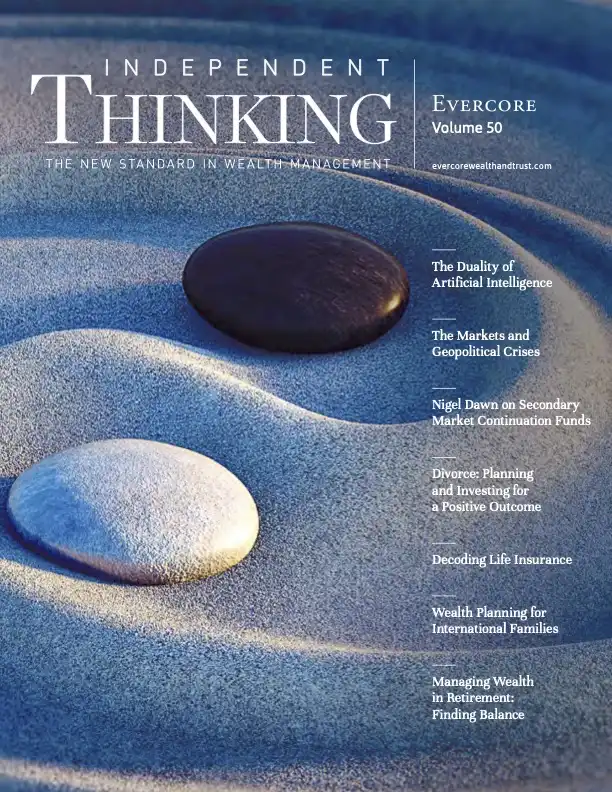
This milestone 50th issue of Independent Thinking® explores key themes shaping global finance, including the economic impact of AI, the resilience of markets amid geopolitical crises, and the growing role of private equity continuation funds.
The publication emphasizes that despite global turmoil, the U.S. economy and markets continue to benefit from robust technological innovation and disciplined long-term investing. It presents timely planning guidance for life events like divorce and retirement, especially as wealth planning becomes more complex in the face of rising longevity, international family dynamics, and the Corporate Transparency Act. Interviews with industry leaders offer insight into evolving investment opportunities, including GP-led secondaries and single-asset continuation vehicles.
Life insurance is also explored as a strategic tool for liquidity, estate equalization, and tax efficiency for high-net-worth families.

Investment and Wealth Management services are provided by Evercore Wealth Management, LLC an investment advisor registered with the U.S. Securities and Exchange Commission (the "SEC") under the Investment Advisers Act of 1940. Registration with the SEC does not imply a certain level of skill or training. Trust and custody services are provided by Evercore Trust Company, N.A. a national trust bank regulated by the Office of the Comptroller of the Currency.
Client retention rate is based on data from 06/30/24 – 06/30/25. Assets under management are as of 06/30/25